Research · Public Oversight Evidence Index
Education Savings Account Audit Reports by State: 2026 Data
By The School Choice Index Editorial Team
Published · Last verified · Dataset version 2026-08-01
7 of 21
direct ESA programs with public independent audit coverage
33.3%
strict audit-coverage share
8 of 21
with an audit or independent limited review
14 of 21
without strict independent audit coverage
By The School Choice Index Editorial Team Last verified: August 1, 2026 · Dataset version: 2026-08-01
This national index of education savings account audit reports by state found public independent audit coverage for 7 of the 21 directly state-funded K–12 ESA programs in the National Conference of State Legislatures’ current published inventory — 33.3% — as of August 1, 2026.
One additional program, Utah Fits All, had a public independent limited review, not an audit. Under the broader audit-or-review definition used for Tier A of the downloadable dataset, the count is 8 of 21 programs, or 38.1%. Nine programs (42.9%) had another form of public oversight material, and four (19.0%) had no final public ESA-specific audit or evaluation we could locate.
Put strictly, 14 of 21 programs — 66.7% — lacked public independent audit coverage. Put more broadly, 13 of 21 — 61.9% — lacked either an independent audit or an independent limited review. Neither statement means those programs had no oversight: nine published another kind of report, and several of the four no-report programs had only recently begun operating or had an audit cycle still ahead of them.
The index counts programs, not states, because Florida operates two directly state-funded ESA programs and Tennessee operates three. Their oversight records are not interchangeable.
Table 1. Public oversight of 21 directly state-funded ESA programs
| Public status | Programs | Share | What the status means |
|---|---|---|---|
| Public independent audit coverage | 7 | 33.3% | An independent audit or audit finding explicitly covered the program |
| Public independent limited review | 1 | 4.8% | Utah’s State Auditor performed a limited review that the document distinguishes from an audit |
| Other public oversight material | 9 | 42.9% | A public evaluation, annual or implementation report, or administrator financial audit exists, but we located no independent state-program audit or review |
| No final public ESA-specific report located | 4 | 19.0% | We located no final public ESA-specific audit or evaluation as of the verification date |
Source: The School Choice Index analysis of the official records listed below. Program universe: NCSL’s current published direct-ESA inventory. Calculations: 7 ÷ 21, 1 ÷ 21, 9 ÷ 21, and 4 ÷ 21. Last verified August 1, 2026.
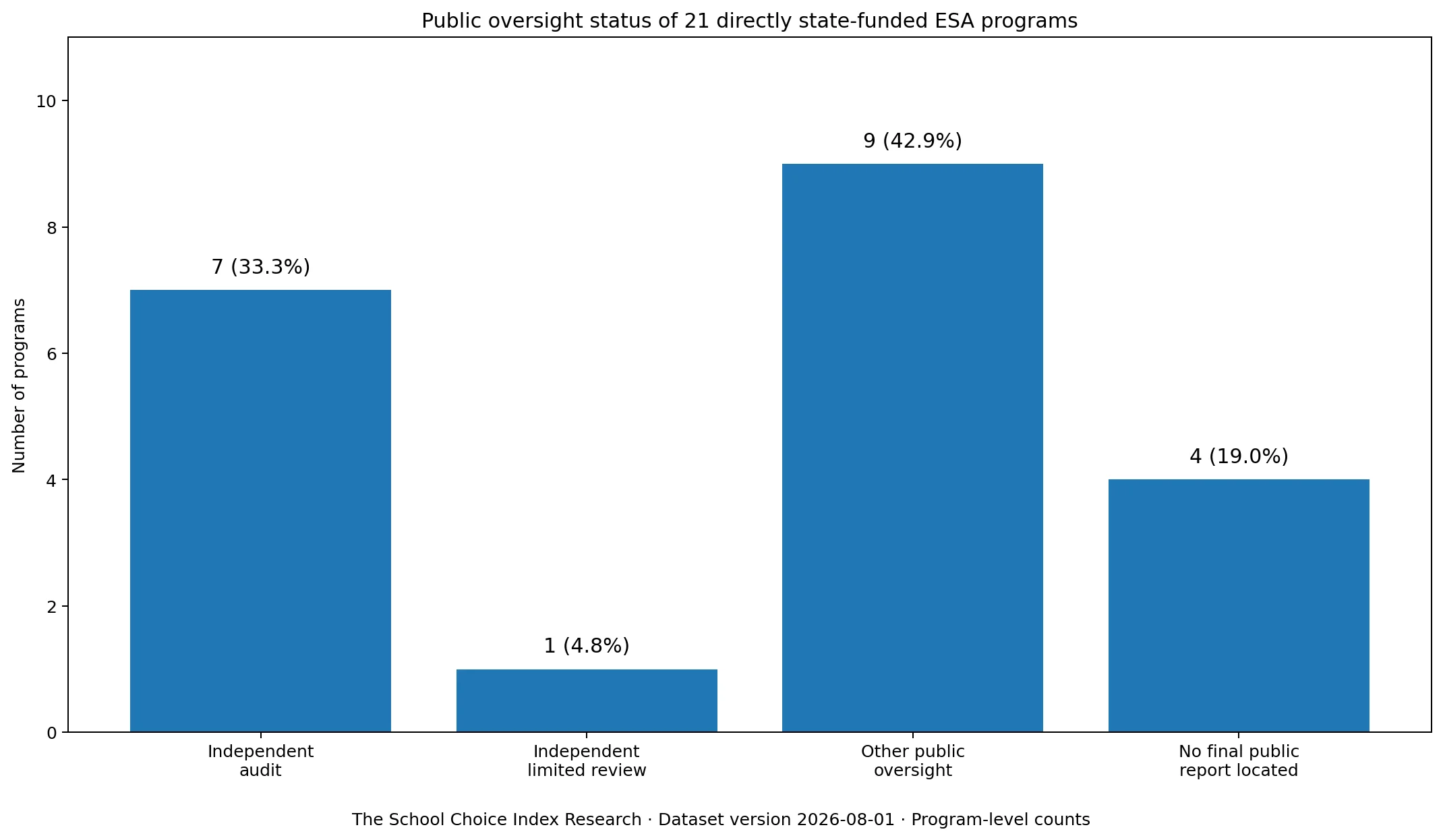
Figure 1 source: The School Choice Index program-level classifications in dataset version 2026-08-01. The downloadable three-tier dataset combines the first two rows above as Tier A: public independent audit-or-review coverage.
Two high-profile sets of ESA findings published in 2026 also need to be named correctly. Arizona’s findings were financial-statement findings inside the state’s annual Single Audit package, not a new standalone ESA performance audit. Iowa’s findings came from the Auditor of State’s FY2024 financial-statement internal-control work; the auditor treated the ESA program as a material class of transactions, while the Department of Education disputed the requested scope.
This page is the register of what exists, plus the vocabulary needed to read it without turning unlike documents into the same thing. Every program row identifies the latest public source we located, who produced it, what period it covered, what kind of work it was, and the limitation that has to travel with any quoted finding.
Education savings account audit reports by state and program
Seven directly state-funded ESA programs had public independent audit coverage, across five states: Arizona, Florida, Indiana, Iowa, and Tennessee. Utah becomes the sixth state only under the broader audit-or-review measure because Utah Fits All received a limited review rather than an audit.
Table 2. Directly state-funded ESA programs and their latest public oversight records
| State | Program | Public status | Latest public source located | Issuer and date | What it covers — and what it does not |
|---|---|---|---|---|---|
| Alabama | Creating Hope and Opportunity for Our Students’ Education (CHOOSE) Act | Other public oversight (B) | 2025 Alabama Department of Revenue Annual Report | Alabama Department of Revenue · Dec. 2025 | Official first-year implementation, application, award, and provider data. It is an agency annual report, not an independent program audit. |
| Arizona | Empowerment Scholarship Accounts | Independent audit coverage (A) | State of Arizona June 30, 2024 Single Audit Report | Arizona Auditor General · Apr. 23, 2026 | Financial-statement findings 2024-02 through 2024-04 examine transaction-review controls, conflicts, and a targeted sample. They are not a standalone ESA performance audit and do not produce a program-wide misspending rate. |
| Arkansas | Arkansas Children’s Educational Freedom Account Program | Other public oversight (B) | 2024–25 Education Freedom Accounts Program Annual Report | Arkansas DESE · Oct. 1, 2025 | Official participation, expenditure, and implementation reporting. A separate Legislative Audit grants report says the information it presents was not audited. |
| Florida | Family Empowerment Scholarship for Educational Options (FES-EO) | Independent audit coverage (A) | Report 2026-046; related Report 2025-185 | Florida Auditor General · Nov. 2025 | The November 2025 report covers statewide funding-accountability processes; the April 2025 administrator audit contains more detailed control findings. Neither supplies a statewide improper-payment rate. |
| Florida | Family Empowerment Scholarship for Students with Unique Abilities (FES-UA) | Independent audit coverage (A) | Report 2026-046; related Report 2025-185 | Florida Auditor General · Nov. 2025 | Funding-accountability and administrator controls, including payment, account-closure, and unused-fund procedures. Findings apply to the tested scope, not every account. |
| Georgia | Georgia Promise Scholarship | No final report located (C) | None located | — | Regulations require annual random student-account audits, an annual Department of Audits and Accounts program audit, and an annual report containing completed audit findings. No final first-cycle report was located. |
| Indiana | Education Scholarship Account Program | Independent audit coverage (A) | FY2023 program financial statement and independent auditor’s report | Independent auditor; filed with Indiana General Assembly · FY2023 | Program financial statements and the independent auditor’s opinion. This is the latest publicly located program-specific audit, not a claim that no later report exists outside the repositories searched. |
| Iowa | Students First Education Savings Account Program | Independent audit coverage (A) | Iowa Department of Education — FY2024 Report of Recommendations | Iowa Auditor of State · Dec. 19, 2025 | FY2024 financial-statement internal-control work. The auditor reported missing requested control documentation and third-party assurance evidence; the Department disputed the requested scope. |
| Louisiana | Louisiana Giving All True Opportunity to Rise (LA GATOR) Scholarship Program | Other public oversight (B) | LA GATOR baseline descriptive evaluation | StudyTrack Research & Analytics; state-hosted · Mar. 2026 | A voluntary, descriptive, noncausal baseline study. The report discloses that StudyTrack is owned by Studyville LLC, an approved GATOR tutoring provider, and discloses one participating student associated with the provider. |
| Mississippi | Equal Opportunity for Students with Special Needs Education Savings Account Program | Other public oversight (B) | PEER Report 710 | Mississippi PEER Committee · Dec. 9, 2024 | A statutory legislative program review covering participation, spending, administration, fiscal effects, and a parent survey. It is not an audit opinion. |
| Montana | Special Needs Equal Opportunity Education Savings Account Program | No final report located (C) | None located | — | No final program audit was located. OPI says a full stay permitted operation through the remainder of the 2025–26 school year; the public page did not establish post-school-year status as of this verification date. |
| New Hampshire | Education Freedom Account Program | Other public oversight (B) | Children’s Scholarship Fund financial statements and independent CPA report | Grant Thornton LLP · Nov. 24, 2025 | An organization-wide financial statement audit that includes EFA-related funds. It is not the state performance audit that legislative records said was underway in 2026. |
| North Carolina | Education Student Accounts for Children with Disabilities (ESA+) | Other public oversight (B) | NCSEAA 2024–25 Annual Report | North Carolina SEAA · Mar. 2026 | Official award and program data, including ESA+. It is not an independent ESA performance or compliance audit. |
| South Carolina | Education Scholarship Trust Fund Program | Other public oversight (B) | Year-one implementation and monitoring report | South Carolina Department of Education · Jan. 2026 | First-year implementation, applications, expenditures, controls, and parent feedback. It is an official monitoring report, not an independent audit opinion. |
| Tennessee | Education Freedom Scholarship Program | Independent audit coverage (A) | Department of Education Performance Audit, pa25005 | Tennessee Comptroller, Division of State Audit · Oct. 14, 2025 | Early implementation through June 4, 2025, within a broader Department audit. The reviewed component produced no finding or observation; it was not a full audit of later awards and transactions. |
| Tennessee | Education Savings Account Pilot Program | Other public oversight (B) | Education Savings Accounts: Program Evaluation | Tennessee Comptroller, OREA · Jan. 2026 | A statutory program evaluation. It says no Comptroller audit report of the pilot had been prepared as of October 2025 and that a program audit was not statutorily required. |
| Tennessee | Individualized Education Account Program | Independent audit coverage (A) | Department of Education Performance Audit, pa25005 | Tennessee Comptroller, Division of State Audit · Oct. 14, 2025 | Eligibility and expenditure samples within a broader Department audit. The reviewed component produced no finding or observation; that result applies only to the tested scope and samples. |
| Texas | Texas Education Freedom Accounts | No final report located (C) | None located | — | Initial account funding began July 1, 2026. State law and the Comptroller’s launch materials describe internal, independent, and State Auditor reviews, but no final public audit or evaluation was located one month into operation. |
| Utah | Utah Fits All Scholarship Program | Independent limited review (A) | Utah Fits All Limited Review, Report 25-49 | Office of the Utah State Auditor · June 26, 2026 | A limited review, not an audit. Detailed category analysis used a 41,070-transaction high-confidence subset from a 212,856-transaction population — about 19.3% — so subset totals cannot be generalized to the full population. |
| West Virginia | Hope Scholarship Program | Other public oversight (B) | Hope Scholarship Annual Report, 2024–25 | West Virginia Hope Scholarship Board · 2025 | Official participation, award, vendor, spending, and financial-summary data. It is an administrator annual report, not an independent program audit. |
| Wyoming | Steamboat Legacy Scholarship Program | No final report located (C) | None located | — | Wyoming law requires an annual random audit of at least 2% of accounts. No final public program audit or evaluation was located. |
Source: The School Choice Index program-level review of the linked primary records. Direct-program universe: NCSL. Tier A in the downloadable dataset groups strict audit coverage and Utah’s limited review; the public-status column keeps them separate. Last verified August 1, 2026.
Table 3. Tax-credit ESA programs tracked separately
| State | Program | Public status | Latest public source located | What it establishes |
|---|---|---|---|---|
| Florida | Florida Tax Credit Scholarship | Independent audit coverage (A) | Florida Auditor General Report 2026-046 and Report 2025-185 | State funding-accountability work and administrator operational-audit coverage |
| Missouri | MOScholars | Independent audit coverage (A) | Missouri State Auditor Report 2025-041 | The State Auditor found that the State Treasurer had not completed the annual program-account audit required to conform to governmental auditing standards and identified oversight weaknesses |
| Utah | Carson Smith Opportunity Scholarship | No final program-specific report located (C) | USBE administrator agreement | The agreement requires annual audited financial statements, but no current public final program-specific audit or audited statement was located under this protocol |
Source: The School Choice Index review of the linked official records. Tax-credit ESA universe: NCSL’s current published tax-credit ESA inventory. These three programs are excluded from the 21-program direct-ESA denominator.
What does this index show — and what does it not show?
This index measures the public availability and type of oversight material for each ESA program. It does not rank program quality, compare audit rigor with a single score, estimate a national fraud rate, or convert findings from targeted samples into population-wide error rates.
Three distinctions do most of the work.
A requirement is not a published report. Georgia, Texas, and Wyoming have identifiable audit or review requirements. That establishes what the law or program design calls for; it does not establish that a final report has been completed or made public.
“No public report located” is not “never audited.” It is a dated result of the search protocol below. States and administrators may conduct account-level checks, internal compliance work, or nonpublic reviews without issuing a statewide public report.
A finding is not a fraud determination. These sources mostly discuss controls, documentation, timing, conflicts, eligibility, administrative procedures, or purchases selected for review. A finding should not be described as fraud unless the issuing authority makes that determination.
The strict and broader headline counts answer different questions. The 7-of-21 strict count asks whether a public independent audit or audit finding covered the program. The 8-of-21 broader count adds Utah’s independent limited review. The downloadable A/B/C dataset preserves the broader three-tier architecture, while the page’s four-status presentation makes the distinction visible.
How did we build this index?
We fixed the unit of analysis at the program level, opened the controlling primary source for every row, and classified each document by what it actually did. Arizona’s detailed transaction tables received an additional transcription and arithmetic check so the original pooled calculations on this page can be reproduced.
Program universe. The direct-program denominator uses the 21 directly state-funded K–12 ESA programs across 18 states in NCSL’s current published inventory. Florida’s two direct programs and Tennessee’s three are separate records. Florida, Missouri, and Utah tax-credit ESAs appear in a separate appendix and do not enter the 21-program calculation.
Search protocol. For each program, we searched the official state auditor, auditor general, comptroller, legislative evaluation, education department, treasury, program-administrator, statutory, regulatory, and legislative repositories. Searches combined the official program name with terms including audit, performance audit, operational audit, financial audit, limited review, evaluation, annual report, random account audit, financial statements, and follow-up.
Source hierarchy. We preferred the report issued by the auditor, evaluator, or responsible agency. An official legislative or state repository was used when it hosted the document. Official agency announcements support current launch or legal-status facts but do not replace the underlying report when a finding is discussed. Commentary, advocacy summaries, and forum posts were not used to classify a program or support a factual finding.
Record-level verification. For every row, we checked the source title, issuer, publication date or date precision, reviewed period, scope, document type, and the limitation required to describe it accurately. A “latest” claim is used only when the official repository supports it; Indiana is deliberately described as the latest publicly located program-specific audit.
Classification. An agency annual report is not an independent program audit merely because it contains expenditure totals. An organization-wide CPA audit of a nonprofit administrator is not a state performance audit of the program. A statutory evaluation is not an audit opinion. Utah’s limited review remains in broader Tier A because it is independent oversight, but it is separately labeled everywhere the strict audit count is presented.
Calculations. The strict public-audit share is 7 ÷ 21 = 33.3%. Utah’s limited review adds 1 ÷ 21 = 4.8%. Other public oversight is 9 ÷ 21 = 42.9%, and no final public report located is 4 ÷ 21 = 19.0%. Percentages are rounded to one decimal place.
Verification date. Every record in dataset version 2026-08-01 was checked on or before August 1, 2026. Montana and other legally volatile rows require a new same-day status check whenever this page is updated.
What counts as an ESA audit or oversight report?
“ESA audit” is often used as a catchall for documents that answer different questions. The eight categories below are this index’s editorial taxonomy, not a government standard; each category is based on the stated objective and scope of the controlling document.
Table 4. Eight document categories used in this index
| Code | Document category | Primary question | What it can establish | Main limitation | ESA example |
|---|---|---|---|---|---|
| D1 | Statewide financial-statement or Single Audit findings | Do statewide financial statements and related controls support reliable reporting? | Material control deficiencies and selected compliance or transaction issues within the financial-audit scope | Not automatically a standalone program-performance audit; targeted samples may be nonprojectable | Arizona; Iowa |
| D2 | Program financial-statement audit | Are the program financial statements fairly presented under the stated accounting framework? | An independent opinion on the statements and related disclosures | Does not answer every operational, eligibility, or transaction-level question | Indiana |
| D3 | Performance audit or performance-audit component | Did operations meet stated criteria, and are controls or results adequate? | Findings tied to audit objectives, criteria, evidence, and tested samples | Scope can cover only one component or time window | Tennessee EFS and IEA; Missouri’s State Treasurer audit |
| D4 | Operational audit | Did an agency or administrator comply with governing requirements and operate controls effectively? | Administrative, control, payment, and compliance findings within the tested scope | Does not create a statewide error rate unless the sampling design supports one | Florida |
| D5 | Independent limited review | What do selected procedures show about a defined set of issues? | Verified observations from the procedures actually performed | Narrower than an audit; does not provide the same breadth or assurance | Utah Fits All |
| D6 | Administrator organization-wide CPA audit | Are the administrator’s organization-wide financial statements fairly presented? | An opinion on the administrator’s books, including program-related funds when included | Not a state performance or compliance audit of every program transaction | New Hampshire |
| D7 | Legislative, statutory, or third-party program evaluation | What does the available evidence show about implementation, participation, costs, or outcomes? | Descriptive or evaluative findings under the stated design | No audit opinion; causal claims require a design that supports them | Mississippi; Tennessee ESA Pilot; Louisiana |
| D8 | Agency or administrator annual or implementation report | What happened during the reporting period? | Official participation, award, spending, provider, or implementation data | Usually produced by the administering body without independent audit assurance | Alabama; Arkansas; North Carolina; South Carolina; West Virginia |
Source: The School Choice Index classification of the report objectives and limitations stated in the primary documents listed in Sources. Government-audit terminology was checked against the U.S. Government Accountability Office’s Government Auditing Standards. Last verified August 1, 2026.
The category name is only a starting point. A reader still has to check the objective, reviewed period, population, sample, procedures, and whether the issuer projects its finding beyond the transactions tested.
Why did Iowa’s ESA controls appear in a statewide financial audit?
Iowa’s report gives a documented example of financial materiality affecting audit scope. It does not establish that materiality explains the national pattern in Table 2, and the final index does not use it that way.
The Auditor of State’s FY2024 report says the Students First ESA program spent approximately $104 million during the fiscal year and was a material class of transactions for the affected financial-statement opinion units. The auditor requested control documentation and a third-party SOC 2 assurance report to understand the design and implementation of relevant controls.
The Department of Education did not provide all requested material and argued that some requests extended beyond the agreed financial-report engagement and would require a separate performance-audit engagement. The Auditor of State disagreed and reported that the missing material limited the office’s ability to determine whether controls were suitably designed and implemented.
Both points belong in the same account. The auditor documented a financial-statement reason for placing the program within FY2024 work. The Department disputed whether the requested procedures fit that engagement. The report does not support the draft’s broader claim that the program first crossed a materiality line in FY2025, so that claim has been removed.
Source: Iowa Auditor of State, Iowa Department of Education — Report of Recommendations for the Year Ended June 30, 2024, dated December 19, 2025; Iowa Department of Education response.
What did Arizona’s 2026 ESA findings actually say?
Arizona’s findings 2024-02, 2024-03, and 2024-04 are financial-statement findings inside the state’s Single Audit Report for the year ended June 30, 2024, signed April 23, 2026. Arizona also has a separate, older ESA performance audit — Report 20-103 from April 2020 — so the two bodies of work should not be blended.
The fiscal-year title does not describe the whole ESA test period
Finding 2024-02 examined automatically processed transactions from December 17, 2024 through January 31, 2026, well after the June 30, 2024 fiscal year in the report title. The report also records that the Auditor General requested read-only access to the ClassWallet system on August 20, 2025 and received it on November 11, 2025.
That timing matters. “Arizona’s FY2024 audit” is an accurate shorthand for the report package, but it is not an accurate description of the full period covered by the ESA transaction testing.
The described review rate and the pooled tested rate were different
Arizona began automatically processing purchases of $2,000 or less in December 2024. Program management described a later risk-based review process, first at 25% and then at 30% of transactions. The Auditor General tested five weeks from September 29 through November 2, 2025 and published the weekly counts.
We summed the five rows and recomputed the pooled rates. Every weekly input reconciled to the report.
Table 5. Arizona ESA transaction-review rate across five tested weeks
| Measure | Transactions | Pooled rate |
|---|---|---|
| Assigned for audit | 48,171 | — |
| Population as the program reported it | 252,496 | 19.1% |
| Transactions omitted from the auditable pool | 52,487 | — |
| Population actually subject to audit after omitted types are added back | 304,983 | 15.8% |
| Rate later described to auditors | — | 30.0% |
| Actual pooled rate as a share of the described rate | — | 52.6% |
Source: The School Choice Index computation from Arizona Auditor General, State of Arizona June 30, 2024 Single Audit Report, finding 2024-02, Table 1. Arithmetic: 48,171 ÷ 252,496 = 19.1%; 48,171 ÷ 304,983 = 15.8%; 15.8% ÷ 30.0% = 52.6%. The report publishes weekly rates; the pooled figures are original calculations. Last verified August 1, 2026.
The pooled rate does not tell us whether the transactions reviewed were representative, whether every selected review was completed, or what share of the full program was improper. It answers a narrower question: what share of the five-week transaction population was assigned for review after omitted transaction types are restored to the denominator.
The targeted sample found issues in 25 of 63 transactions
Finding 2024-04 used a judgmental, nonprojectable sample of 63 selected transactions totaling $251,446. Auditors reported issues in 25 transactions — 39.7% of that targeted sample — with a stated subtotal of $86,599.
Table 6. Arizona’s displayed issue categories in the 63-transaction sample
| Issue category | Transactions | Amount |
|---|---|---|
| Missing or insufficient documentation | 11 | $42,760 |
| Indicators of possible misuse | 2 | $17,531 |
| Missing accreditation evidence | 7 | $14,175 |
| Overpayments | 3 | $9,977 |
| Unallowable expenses | 2 | $2,155 |
| Report’s stated subtotal | 25 | $86,599 |
Source: Arizona Auditor General, State of Arizona June 30, 2024 Single Audit Report, finding 2024-04. The sample was judgmental and nonprojectable. The five displayed category amounts sum to $86,598, while the report’s subtotal and finding state $86,599; this page preserves the report’s stated subtotal and flags the one-dollar internal discrepancy. Last verified August 1, 2026.
The distinction between possible misuse, missing documentation, overpayment, and a determined unallowable expense is not cosmetic. Those labels describe different evidentiary states. The stated $86,599 subtotal is not a population estimate and cannot be divided by the whole program to produce a statewide misspending rate.
The $654.4 million figure is exposure, not misspending
The same report says 2,289,232 transactions totaling $654,439,115 were automatically processed between December 17, 2024 and January 31, 2026. That number measures the volume that bypassed manual review; it does not measure how much was improper.
The opposite error is just as serious: treating the targeted sample’s stated $86,599 subtotal as if it were a program-wide rate. One number describes exposure to limited review. The other describes issues found in a selected, nonprojectable sample. Neither is a statewide misspending estimate.
Conflict controls produced a separate finding
Finding 2024-03 examined conflict-of-interest handling. Auditors reviewed all 266 transactions for two families flagged in connection with the program’s executive director and identified 47 transactions totaling $4,031 with missing documentation, unallowable expenses, or overpayments. The report also says 90 transactions totaling $44,120 associated with disclosed employee relationships did not receive the independent review called for by the program’s process, including a $665 transaction in which an employee approved a reimbursement involving her own child.
The Arizona Department of Education did not concur with the findings. Its published response argues that the Auditor General evaluated policy and process choices beyond legal compliance and that automatically processed orders remained subject to later review. The Auditor General’s response says the documented deficiencies showed that controls were not designed or operating as intended and that delays could close recovery windows. Both positions are part of the official report.
Why are published ESA misspending numbers not comparable?
The public record does not support a national ESA misspending rate. Published figures measure different things, use different populations and samples, and often sit at different stages between a control exception and a final determination.
Table 7. Different numbers that are often collapsed into “misspending”
| Finding type | What it establishes | Verified example | What it does not establish |
|---|---|---|---|
| Determined unallowable expense | The tested expense did not meet the governing rules | Arizona: 2 transactions totaling $2,155 in the targeted sample | A statewide rate |
| Possible misuse indicator | The transaction displayed a specified risk indicator and required further action | Arizona: 2 transactions totaling $17,531 | A final fraud or misuse determination |
| Missing documentation | Required evidence was not available or sufficient | Arizona: 11 transactions totaling $42,760 | That the underlying purchase was necessarily improper |
| Overpayment | The payment exceeded the support auditors found | Arizona: 3 transactions totaling $9,977 | The frequency of overpayments across the program |
| Unreviewed exposure | Transactions bypassed manual review | Arizona: 2,289,232 transactions totaling $654,439,115 | Misspending |
| Lawful but criticized spending | A reviewer judged selected purchases wasteful or extravagant under the reviewed year’s rules | Utah Fits All limited review | Illegality, or a full-population rate |
| Program cost or participation data | How much a program spent or how many people participated | Annual reports in Alabama, North Carolina, and West Virginia | Transaction compliance or fraud |
Source: The School Choice Index classification of the Arizona and Utah findings and the annual reports linked in Table 2. Last verified August 1, 2026.
The denominator problem is simple. A numerator drawn from a targeted high-risk sample cannot be divided by the entire program to create a population rate. A large unreviewed transaction volume cannot be relabeled as improper spending. A lawful purchase criticized on value grounds cannot be relabeled illegal.
The honest conclusion is narrower and more useful: the public reports show specific weaknesses, selected improper or unsupported transactions, and uneven review systems. They do not show how much ESA spending nationwide was misspent.
What did the other recent ESA audits and reviews find?
The findings do not point in one direction. Some reports identified control and documentation weaknesses; some reviewed components produced no findings; Utah’s limited review identified selected purchases it criticized while saying most reviewed spending supported legitimate educational activity.
Table 8. Findings that can be quoted safely — and the qualifier that must travel with them
| Program | Safe finding | Required qualifier |
|---|---|---|
| Arizona ESA | The Auditor General reported material weaknesses in the program’s transaction-review, conflict, and follow-up controls. | These are financial-statement findings, not a new standalone ESA performance audit. The targeted sample was nonprojectable, and the Department did not concur. |
| Iowa Students First | The Auditor of State reported that requested control documentation and the administrator’s SOC 2 report were not provided, limiting the office’s ability to determine aspects of control design and implementation. | The Department disputed the requested scope. The finding arose from FY2024 financial-statement internal-control work, not a standalone ESA performance audit. |
| Tennessee Education Freedom Scholarship | The reviewed implementation component produced no finding or observation. | The audit covered implementation through June 4, 2025, not the program’s later mature transaction history. |
| Tennessee Individualized Education Account | Reviewed eligibility and expenditure samples produced no finding or observation. | A no-finding result applies to the stated samples and procedures, not every account. |
| Tennessee ESA Pilot | The January 2026 evaluation says no Comptroller audit report of the pilot had been prepared as of October 2025. | The same evaluation says a program audit was not statutorily required; this is not a finding that officials failed to perform a mandated audit. |
| Utah Fits All | The State Auditor’s limited review said most funds supported legitimate educational activities and identified selected purchases described as wasteful or extravagant. | The document is a limited review, not an audit. Detailed category analysis used 41,070 of 212,856 transactions — about 19.3% — and cannot be extrapolated to the full population. |
| Missouri MOScholars | The State Auditor found that the State Treasurer had not conducted the required annual program-account audit in conformity with governmental auditing standards. | This is an audit finding that the required program-account audit had not been performed; it is not the missing full program-account audit. |
| Florida FES and FTC programs | Florida Auditor General reports identified funding-accountability and administrator-control issues, including payment and account procedures. | These are findings within the tested processes and periods, not a statewide improper-payment rate. |
Source: The linked Arizona, Iowa, Tennessee, Utah, Missouri, and Florida primary reports. Last verified August 1, 2026.
Utah needs one more sentence because its finding category is unusual. Some purchases criticized in the 2024–25 review were lawful under the rules then in force, while Utah changed allowable-expense rules for 2025–26. “Wasteful” in that report is the State Auditor’s fiscal judgment, not a determination that every cited purchase was illegal.
Which programs publish evaluations or annual reports instead of audits?
Nine directly state-funded ESA programs had useful public oversight material but no public independent state-program audit or independent limited review located. These documents can be the best available source for participation, spending, or implementation data; they simply answer different questions.
Agency and administrator annual reports. Alabama’s 2025 Department of Revenue report recorded 23,230 tentative CHOOSE awards totaling $123.935 million. Arkansas published a full 2024–25 EFA annual report, while a separate Legislative Audit grants report expressly says the information it presents was not audited. North Carolina’s NCSEAA annual report supplies ESA+ program data. West Virginia’s 2024–25 report recorded 10,530 scholarships awarded and $43.766 million in student-account spending, while disclosing classification limits in part of its purchase data.
Legislative and statutory evaluations. Mississippi PEER reported $5.1 million disbursed and 515 participants for fiscal year 2023–24, alongside administrative and parent-survey findings. Tennessee OREA’s January 2026 ESA Pilot evaluation covers design, implementation, participation, fiscal effects, and available outcomes without issuing an audit opinion.
Implementation and monitoring. South Carolina’s January 2026 year-one report documents the Education Scholarship Trust Fund’s first operating year. It is official monitoring material, not independent audit assurance.
Administrator and third-party material. New Hampshire’s November 24, 2025 Grant Thornton report gives an unmodified opinion on the Children’s Scholarship Fund’s organization-wide financial statements, including EFA-related funds. A New Hampshire legislative record said an LBA performance audit of the EFA program was underway in 2026; no final public report was located as of August 1. Louisiana’s March 2026 report is voluntary, descriptive, and noncausal, and its provider-affiliation disclosure belongs beside any use of its findings.
Sources: Alabama, Arkansas, Mississippi, New Hampshire, Louisiana, North Carolina, South Carolina, Tennessee, and West Virginia records linked in Table 2.
Which programs require an audit but have not published a final report?
Georgia, Texas, and Wyoming have identifiable public audit or random-review requirements but no final public ESA-specific audit or evaluation located as of August 1, 2026. Montana is a different case: the immediate uncertainty is the program’s legal and operational posture after the 2025–26 school year.
Georgia — Georgia Promise Scholarship. Regulations approved in May 2026 and effective July 1, 2026 require annual random student-account audits, an annual Department of Audits and Accounts program audit, and an annual report that includes completed audit findings. No final first-cycle report was located.
Texas — Texas Education Freedom Accounts. The Comptroller announced that nearly 73,000 accounts would receive initial funding on July 1, 2026. Enrolled Senate Bill 2 establishes certified-organization and State Auditor review mechanisms, including State Auditor random selection of 10% of applications. No final report was located one month into operation.
Wyoming — Steamboat Legacy Scholarship. Wyoming law requires the Superintendent to conduct or contract for an annual random audit of at least 2% of all accounts. No final public audit or evaluation was located.
Montana — Special Needs Equal Opportunity ESA. No final program audit was located. Montana OPI’s public page states that a full stay allowed the program to operate through the remainder of the 2025–26 school year; the page did not resolve post-school-year operation as of this verification date. Montana must be rechecked against the controlling court order and OPI notice before any later update.
Sources: Georgia Promise Scholarship regulations; Texas Comptroller launch announcement and enrolled SB 2; Wyoming education statutes; Montana OPI ESA page.
Why does this matter now?
The program universe is no longer made up only of small, long-running special-needs accounts. Texas launched initial funding for nearly 73,000 accounts in July 2026, while Arizona’s official audit report shows enrollment rising from 61,689 students on June 30, 2023 to 102,532 in April 2026.
Oversight can also arrive long after the period named in a report. Arizona’s Single Audit package for the fiscal year ended June 30, 2024 was signed April 23, 2026, and the package reports that the state submitted its federal Single Audit materials nearly thirteen months after the March 31, 2025 deadline. Its ESA transaction testing continued into January 2026.
New Hampshire shows the opposite problem: a program can have an administrator financial-statement audit in public while the state performance audit remains underway. Readers need both the document and the document type to know what has actually been examined.
The practical reason for maintaining this index is not that every new report changes the national conclusion. It is that a new audit, limited review, court order, or first-year report can change one program’s classification overnight — and every national percentage has to change with it.
Sources: Texas Comptroller; Arizona Auditor General; New Hampshire House Record.
What are the limitations of this data?
This dataset is designed to make unlike records comparable without pretending they are identical. Its strongest claims are the report register, the document classifications, the dated source links, and the arithmetic derived from those classifications.
The counts depend on published definitions. A different reasonable definition of “audit coverage” can produce a different number. That is why the page shows both the strict 7-of-21 audit count and the broader 8-of-21 audit-or-review count, and why the complete record-level data is downloadable.
The program universe is fixed to NCSL’s current published inventory. The direct-ESA scan is marked updated July 21, 2025. It remains NCSL’s current published inventory and is consistent with The School Choice Index’s 2026 ESA statistics dataset, but any later statutory change should trigger a denominator review rather than being silently absorbed.
Absence claims are the weakest records. “No public report located” means no final public ESA-specific audit or evaluation was found under the stated protocol by August 1, 2026. It does not prove that no unpublished, internal, incomplete, or account-level review exists.
Report periods and objectives are not interchangeable. A first-year implementation report, financial-statement audit, performance-audit component, administrator CPA audit, and limited review answer different questions over different windows.
Sample percentages are not population estimates unless the report’s design says they are. Arizona’s 63-transaction sample was judgmental and nonprojectable. Utah’s detailed category analysis used a 41,070-transaction high-confidence subset representing about 19.3% of the full transaction population.
Legal status can change faster than the dataset. Montana requires a same-day recheck. Newly launched programs such as Texas and Georgia require frequent review around their first statutory reporting cycles.
The index does not produce a national misspending rate. The public figures measure incompatible things: determined unallowable expenses, possible misuse indicators, missing documentation, overpayments, unreviewed exposure, administrator performance, and spending criticized on value grounds. Combining them would create a number the evidence does not support.
Where can the education savings account audit dataset be downloaded?
The full dataset is published as dated CSV and JSON files, with a separate data dictionary and chart. Frozen version numbers preserve the classifications and source record behind every national percentage.
- CSV — ESA audit reports by state, version 2026-08-01
- JSON — ESA audit reports by state, version 2026-08-01
- Data dictionary — version 2026-08-01
- Figure 1 — public oversight status

The CSV includes both the strict audit field and the broader audit-or-review field, so researchers can reproduce either headline count without inferring how Utah was treated.
Dataset version history
| Version | Verification date | Material changes |
|---|---|---|
| 2026-08-01 | August 1, 2026 | Initial public release: 21 direct ESA programs, 3 tax-credit ESA programs, strict audit count separated from Utah’s limited review |
Source: The School Choice Index dataset release log.
How should this page be cited?
The citation below identifies the editorial producer, page title, dataset version, and verification date. It is provided so different versions of the dataset are not confused with one another.
Suggested citation
The School Choice Index Editorial Team. “Education Savings Account Audit Reports by State: 2026 National Index.” The School Choice Index Research. Dataset version 2026-08-01. Last verified August 1, 2026. https://theschoolchoiceindex.com/research/education-savings-account-audit-reports-by-state/
With a retrieval date
The School Choice Index Editorial Team. “Education Savings Account Audit Reports by State: 2026 National Index.” The School Choice Index Research. Dataset version 2026-08-01. Accessed [Month Day, Year]. https://theschoolchoiceindex.com/research/education-savings-account-audit-reports-by-state/
Frequently asked questions about education savings account audits
What is an education savings account audit?
An ESA audit may examine financial statements, internal controls, eligibility, account transactions, allowable expenses, legal compliance, or program performance. The objectives and scope determine what the report can establish, so a financial-statement audit, performance audit, operational audit, and limited review should not be treated as interchangeable.
Which states have independent audit coverage of ESA programs?
As of August 1, 2026, seven of the 21 directly state-funded ESA programs had public independent audit coverage. Those seven programs operate in five states: Arizona, Florida, Indiana, Iowa, and Tennessee. Utah becomes a sixth state only under the broader measure because Utah Fits All received an independent limited review rather than an audit.
Are ESA annual reports the same as audits?
No. An annual report can provide official participation, award, and spending figures without independent testing, an audit opinion, or conclusions about internal controls. Arkansas makes the distinction explicit in a separate Legislative Audit grants report that says the information presented there was not audited.
Do all states require random ESA account audits?
No. Requirements vary. Wyoming requires an annual random audit of at least 2% of accounts; Georgia requires annual random student-account audits and an annual program audit; Texas requires several layers of review, including State Auditor random selection of 10% of applications. A requirement does not establish that a final public report has been issued.
Have ESA audits found fraud?
The reports reviewed for this release rarely make formal fraud determinations. Most findings concern control design, documentation, delayed review, conflicts, overpayments, unsupported transactions, or selected questionable purchases. A finding should not be described as fraud unless the issuing authority establishes fraud.
How much ESA money has been found misspent?
There is no defensible national figure. Published amounts measure different things, including determined unallowable expenses, possible misuse indicators, missing documentation, overpayments, and transactions that bypassed manual review. Arizona’s stated $86,599 subtotal came from a targeted, nonprojectable sample; its $654.4 million figure measures automatically processed transaction volume, not misspending.
Does a program with no audit findings have no problems?
No. A no-finding result supports only the report’s objectives, reviewed period, procedures, and samples. Tennessee’s Education Freedom Scholarship component produced no finding, but the work covered implementation only through June 4, 2025.
Why did Iowa’s ESA program appear in financial-statement audit work?
The Iowa Auditor of State reported that approximately $104 million in FY2024 ESA expenditures made the program a material class of transactions for affected financial-statement opinion units. The Department disputed whether the auditor’s requested control work fit the engagement. The report documents that specific FY2024 scoping disagreement; it does not establish a universal rule for other states.
How often is this index updated?
The published maintenance schedule calls for monthly source-register checks, quarterly full-dataset reverification, and event-driven updates when a new audit, evaluation, court order, or program-status change becomes public. The version number and verification date at the top identify the release being read.
Related research
- Education Savings Account Statistics 2026: Programs, Enrollment, Funding and Rules
- School Choice Statistics 2026: Programs, Students and Public Spending
- School Voucher Tuition Gap by State
Sources
Program universe and audit standards
- National Conference of State Legislatures — Education Choice State Policy Scan: Education Savings Accounts
- National Conference of State Legislatures — Education Choice State Policy Scan: Tax-Credit Education Savings Accounts
- U.S. Government Accountability Office — Government Auditing Standards
Arizona
- Arizona Auditor General — State of Arizona June 30, 2024 Single Audit Report
- Arizona Auditor General — FY2024 Financial and Single Audit Highlights
- Arizona Auditor General — Empowerment Scholarship Accounts Program, Report 20-103 and follow-ups
- Arizona Revised Statutes § 15-2403
Iowa
- Iowa Auditor of State — Iowa Department of Education, Report of Recommendations for the Year Ended June 30, 2024
- Iowa Department of Education — official response concerning the Auditor of State
Florida
- Florida Auditor General — Department of Education, 2024–25 School Year Funding Accountability Challenges, Report 2026-046
- Florida Auditor General — Step Up For Students — Florida, Inc., Report 2025-185
Tennessee
- Tennessee Comptroller — Department of Education Performance Audit, pa25005
- Tennessee Comptroller, OREA — Education Savings Accounts: Program Evaluation
Utah
- Office of the Utah State Auditor — Utah Fits All Limited Review, Report 25-49
- Office of the Utah State Auditor — Recent Audit Reports
- Utah State Board of Education — Carson Smith administrator agreement
Other state programs
- Alabama Department of Revenue — 2025 Annual Report
- Arkansas Division of Elementary and Secondary Education — 2024–25 EFA Annual Report
- Arkansas Legislative Audit — Education Grants report
- Georgia Promise Scholarship Program Regulations, approved May 2026
- Indiana General Assembly — Education Scholarship Account FY2023 financial statement and independent auditor’s report
- Louisiana Office of the Governor — LA GATOR baseline descriptive evaluation
- Mississippi PEER Committee — Report 710
- Missouri State Auditor — Office of State Treasurer, Report 2025-041
- Montana Office of Public Instruction — Education Savings Account
- Montana court docket document
- Children’s Scholarship Fund — 2025 financial statements and independent CPA report
- New Hampshire House Record — January 30, 2026
- North Carolina State Education Assistance Authority — 2024–25 Annual Report
- South Carolina Education Scholarship Trust Fund — year-one report
- Texas Comptroller — nearly 73,000 accounts to receive initial funding July 1
- Texas Legislature — enrolled Senate Bill 2
- West Virginia Hope Scholarship Board — 2024–25 Annual Report
- West Virginia Hope Scholarship — Annual Reports
- Wyoming Department of Education — Education Savings Accounts
- Wyoming Statutes, Title 21
The School Choice Index is an independent, non-partisan editorial reference for U.S. K–12 school-choice programs. Its research section publishes sourced datasets and explanatory resources about those programs. This page was produced by The School Choice Index Editorial Team, which fixed the program universe, opened the controlling primary source for every record, classified each document by its actual function and scope, and verified the record set for dataset version 2026-08-01.