Research · Provider Accountability Dataset
School Voucher Provider Accountability Requirements by State
By The School Choice Index Editorial Team
Published · Last verified · Dataset version 1.0-2026-08-03
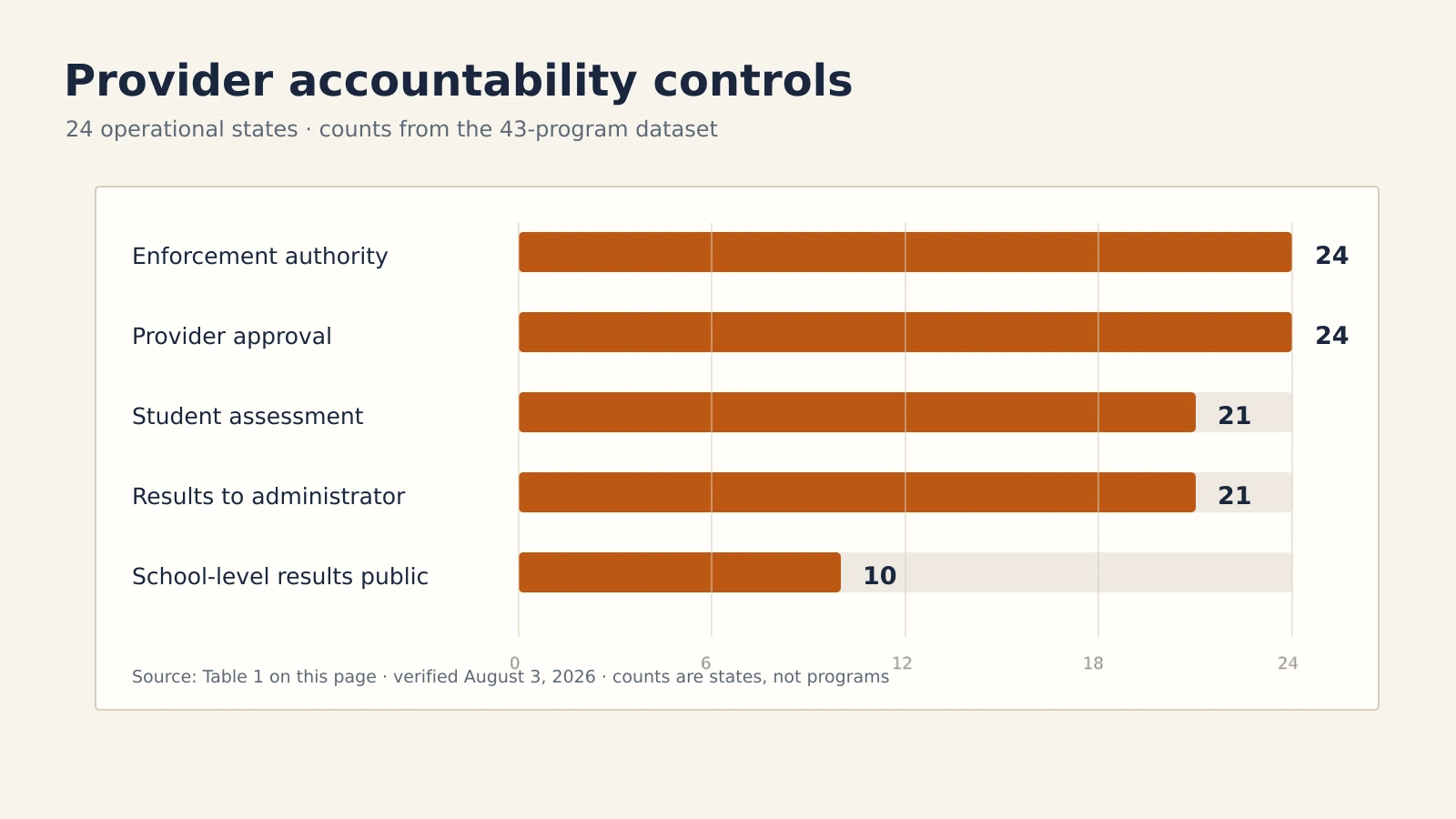
“Across the 24 states with a verified operational program, 21 require an assessment in at least one program, 21 require results to reach an administrator, 10 make any of it public at the school level, and zero require unconditional school-level publication across every program.”
That is from our own review of 43 separately coded programs across 25 states, verified August 3, 2026, using one published codebook. School voucher provider accountability requirements by state do not disappear in one place. They thin out in a specific sequence: testing is common, reporting to an agency or administrator is just as common, and public disclosure attributable to a named school is rare.
There is a second finding, and it is the one we did not go looking for. In a targeted review of the program statutes, six states put an express limit on what the state may require of a participating provider in the same law that creates the program. Arizona goes furthest: in a legal challenge over the chapter's application to a qualified school, the state bears the burden of showing that the law is necessary and does not impose an undue burden.
Jump to: The headline data · The 50-state scope · The 24-state matrix · All 43 programs · The testing-to-publication gap · Background checks · Statutory limits on regulation · Methodology · Limitations · How to cite
School voucher provider accountability requirements by state: the headline data
Answer capsule: Across 24 states with a verified operational voucher, education savings account, town-tuitioning, or refundable parental-choice mechanism as of August 3, 2026, every state had provider approval and enforcement authority in place. Twenty-one required assessment in at least one program, 21 required results to reach an administrator, 10 had any school-level public-results rule, and none required unconditional school-level publication across every program it operated.
| Accountability control | States: all programs | States: some or conditional | States: none found | States: N/A | States with any |
|---|---|---|---|---|---|
| Provider approval or registration | 20 | 4 | 0 | 0 | 24 |
| Complaint, investigation, suspension, or termination authority | 24 | 0 | 0 | 0 | 24 |
| Tuition, fee, or refund transparency | 11 | 13 | 0 | 0 | 24 |
| Staff background checks | 10 | 11 | 3 | 0 | 21 |
| Student assessment | 11 | 10 | 3 | 0 | 21 |
| Results reported to state or administrator | 10 | 11 | 3 | 0 | 21 |
| Health, safety, or code compliance | 7 | 13 | 4 | 0 | 20 |
| Teacher or provider qualifications | 5 | 15 | 4 | 0 | 20 |
| Accreditation or baseline eligibility | 9 | 10 | 5 | 0 | 19 |
| Account-holder or transaction audit | 11 | 8 | 0 | 5 | 19 |
| Ongoing provider financial audit or review | 6 | 10 | 8 | 0 | 16 |
| Financial viability at entry | 5 | 10 | 9 | 0 | 15 |
| School-level results publicly reported | 0 | 10 | 14 | 0 | 10 |
Source: The School Choice Index, “School Voucher Provider Accountability Requirements by State,” 43-program dataset, verified August 3, 2026. Counts are of states, not programs. “N/A” means structurally inapplicable; a direct-payment voucher with no family-controlled account has no family account to audit.
Two rows are worth pausing on. Enforcement is the only control that is universal. Every operational state in the dataset has express authority to investigate, deny, suspend, terminate, recoup, refer suspected fraud, or otherwise enforce its program rules. That cuts against the shorthand that these programs have no oversight. They all have a stick. The trigger and process are what differ.
Public disclosure is the only control with a zero in the first column. No state requires unconditional publication of school-level academic results across every program it runs. Ten states have a public-results rule somewhere, always subject to a program, grade, enrollment, participation, funding-share, or cohort-size condition.
The distance between those two rows is the story.
Why do 21 states require testing but only 10 publish school-level results?
Answer capsule: Requiring a test, requiring the results to reach a state or program administrator, and making the results public at the school level are three separate decisions. In this review, 21 operational states required an assessment in at least one program, 21 required results to reach an administrator, and 10 had any school-level public-results rule. The drop from assessment to school-level public disclosure is 11 states.
Most coverage collapses those decisions into one question — “are voucher schools tested?” — and gets a misleading answer either way.
| Step | States with the requirement in at least one program | Drop from prior step |
|---|---|---|
| A participating student must take an assessment | 21 | — |
| Results must reach a state agency or program administrator | 21 | 0 |
| Results are publicly available attributable to a named school | 10 | −11 |
| Publication is unconditional across every program the state runs | 0 | −10 |
Source: The School Choice Index, 43-program dataset, verified August 3, 2026. “Assessment” includes a state test, a nationally norm-referenced test, a portfolio review, or another specified academic measure. Reporting results only to parents is not counted.
The ten states with a school-level public-results rule in at least one program are Alabama, Florida, Indiana, Iowa, Maine, North Carolina, Ohio, South Carolina, Vermont, Wisconsin.
| State | Programs with a public school-level results rule | Of total operational programs |
|---|---|---|
| Alabama | 1 | 1 |
| Florida | 1 | 2 |
| Indiana | 1 | 2 |
| Iowa | 1 | 1 |
| Maine | 1 | 1 |
| North Carolina | 2 | 2 |
| Ohio | 3 | 5 |
| South Carolina | 1 | 1 |
| Vermont | 1 | 1 |
| Wisconsin | 4 | 4 |
Source: The School Choice Index, 43-program dataset, verified August 3, 2026. Counts include program rows coded Yes or Limited/conditional on the public-results field. Alabama's rule does not require a school with fewer than 20 participating students to report school-level results. South Carolina's named-school report applies when at least 51 percent of a private school's enrollment participated in the prior year or at least 30 participating students have test scores, subject to a possible lower privacy-safe cell size of no fewer than 10.
Alabama and Arkansas show why the exact object of publication matters. Alabama Rule 810-28-1-.05 makes submitted school-level test results public records, with no school-level report when fewer than 20 participating students are enrolled. Arkansas Rule 6 CAR § 35-112 allows public release of survey results at an aggregated school level; it does not create school-level public release of the academic-assessment results sent to the department. Alabama is therefore in the ten-state public-results group. Arkansas is not.
Ohio shows the same problem inside one state. Three of its five operational programs carry a public-results rule and two do not; the two without it are the Autism and Jon Peterson special-education scholarships. A bare yes or no for “Ohio” loses the program-level answer.
The program-level distribution is starker.
| Accountability control | Yes | Conditional | None found | N/A |
|---|---|---|---|---|
| Complaint, investigation, suspension, or termination authority | 42 | 0 | 0 | 0 |
| Provider approval or registration | 38 | 4 | 0 | 0 |
| Staff background checks | 23 | 14 | 5 | 0 |
| Student assessment | 24 | 14 | 4 | 0 |
| Results reported to state or administrator | 23 | 14 | 5 | 0 |
| Accreditation or baseline eligibility | 20 | 16 | 6 | 0 |
| Account-holder or transaction audit | 20 | 2 | 0 | 20 |
| Tuition, fee, or refund transparency | 18 | 24 | 0 | 0 |
| Health, safety, or code compliance | 15 | 22 | 5 | 0 |
| Teacher or provider qualifications | 16 | 20 | 6 | 0 |
| Financial viability at entry | 12 | 10 | 20 | 0 |
| Ongoing provider financial audit or review | 10 | 12 | 20 | 0 |
| School-level results publicly reported | 6 | 10 | 26 | 0 |
Source: The School Choice Index, program-detail dataset, verified August 3, 2026.
Twenty-six of 42 operational programs — 62 percent — carry no school-level public-results rule that we could identify. Entry-stage financial viability and ongoing provider financial review each have 20 programs with no express requirement found. Public disclosure is the least common of the thirteen controls in this codebook.
Which states are included in the 2026 school voucher accountability dataset?
Answer capsule: Twenty-five states had at least one enacted mechanism inside this page's defined scope on August 3, 2026. Twenty-four had at least one verified operational mechanism. Montana had an enacted program but was not counted as operational for 2026–27 because the official stay language located during review permitted administration only through June 30, 2026. The other 25 states had no in-scope mechanism identified.
| State | Status in this dataset | Included program count |
|---|---|---|
| Alabama | Operational | 1 |
| Alaska | No in-scope program identified | 0 |
| Arizona | Operational | 1 |
| Arkansas | Operational | 1 |
| California | No in-scope program identified | 0 |
| Colorado | No in-scope program identified | 0 |
| Connecticut | No in-scope program identified | 0 |
| Delaware | No in-scope program identified | 0 |
| Florida | Operational | 2 |
| Georgia | Operational | 2 |
| Hawaii | No in-scope program identified | 0 |
| Idaho | Operational | 1 |
| Illinois | No in-scope program identified | 0 |
| Indiana | Operational | 2 |
| Iowa | Operational | 1 |
| Kansas | No in-scope program identified | 0 |
| Kentucky | No in-scope program identified | 0 |
| Louisiana | Operational | 2 |
| Maine | Operational | 1 |
| Maryland | Operational | 1 |
| Massachusetts | No in-scope program identified | 0 |
| Michigan | No in-scope program identified | 0 |
| Minnesota | No in-scope program identified | 0 |
| Mississippi | Operational | 3 |
| Missouri | No in-scope program identified | 0 |
| Montana | Enacted; 2026–27 operation not verified | 1 |
| Nebraska | No in-scope program identified | 0 |
| Nevada | No in-scope program identified | 0 |
| New Hampshire | Operational | 1 |
| New Jersey | No in-scope program identified | 0 |
| New Mexico | No in-scope program identified | 0 |
| New York | No in-scope program identified | 0 |
| North Carolina | Operational | 2 |
| North Dakota | No in-scope program identified | 0 |
| Ohio | Operational | 5 |
| Oklahoma | Operational | 2 |
| Oregon | No in-scope program identified | 0 |
| Pennsylvania | No in-scope program identified | 0 |
| Rhode Island | No in-scope program identified | 0 |
| South Carolina | Operational | 1 |
| South Dakota | No in-scope program identified | 0 |
| Tennessee | Operational | 3 |
| Texas | Operational | 1 |
| Utah | Operational | 2 |
| Vermont | Operational | 1 |
| Virginia | No in-scope program identified | 0 |
| Washington | No in-scope program identified | 0 |
| West Virginia | Operational | 1 |
| Wisconsin | Operational | 4 |
| Wyoming | Operational | 1 |
Source: The School Choice Index 50-state scope review, verified August 3, 2026. The District of Columbia is excluded from the state denominator. Donation-funded tax-credit scholarship programs are outside the principal matrix because their accountability chain runs through scholarship-granting organizations.
The 24 operational states are Alabama, Arizona, Arkansas, Florida, Georgia, Idaho, Indiana, Iowa, Louisiana, Maine, Maryland, Mississippi, New Hampshire, North Carolina, Ohio, Oklahoma, South Carolina, Tennessee, Texas, Utah, Vermont, West Virginia, Wisconsin, Wyoming.
The 25 states with no in-scope mechanism identified are Alaska, California, Colorado, Connecticut, Delaware, Hawaii, Illinois, Kansas, Kentucky, Massachusetts, Michigan, Minnesota, Missouri, Nebraska, Nevada, New Jersey, New Mexico, New York, North Dakota, Oregon, Pennsylvania, Rhode Island, South Dakota, Virginia, Washington.
“Not identified” is a scope conclusion, not a statement that a state has no private-school rules. General private-school law, tax law, child-safety law, licensing law, consumer-protection law, and criminal law can still apply.
What are the accountability requirements in my state?
Answer capsule: The matrix below compares the same thirteen controls across all 24 states with a verified operational in-scope program. A means every operational program in that state carries an unconditional requirement. C means the state has the requirement in at least one program or only under a stated condition. A dash means no express requirement was found in the program sources reviewed.
Legend: A = all operational programs · C = some programs or conditional · — = no explicit requirement found · n/a = structurally inapplicable
| State | Programs | Appr | Accr | Bkgd | H&S | FinE | AudP | AudA | Test | Rept | Pub | Price | Enf | Qual |
|---|---|---|---|---|---|---|---|---|---|---|---|---|---|---|
| Alabama | 1 | A | A | A | A | A | C | A | A | A | C | A | A | C |
| Arizona | 1 | C | — | C | — | — | — | A | — | — | — | C | A | — |
| Arkansas | 1 | A | A | A | A | A | A | A | A | A | — | A | A | C |
| Florida | 2 | A | C | A | A | A | C | A | C | C | C | C | A | A |
| Georgia | 2 | A | A | C | A | C | C | C | C | C | — | C | A | C |
| Idaho | 1 | C | C | — | — | — | — | C | — | — | — | C | A | — |
| Indiana | 2 | A | C | C | C | C | — | C | A | A | C | C | A | A |
| Iowa | 1 | C | A | C | C | — | — | A | A | A | C | A | A | C |
| Louisiana | 2 | A | A | C | A | C | C | C | C | C | — | C | A | C |
| Maine | 1 | A | A | C | C | C | C | n/a | C | C | C | A | A | C |
| Maryland | 1 | A | C | C | C | — | — | n/a | A | A | — | C | A | C |
| Mississippi | 3 | A | C | C | C | — | C | C | C | C | — | C | A | C |
| New Hampshire | 1 | A | — | — | — | — | — | A | A | A | — | A | A | — |
| North Carolina | 2 | A | — | C | C | — | C | C | A | A | C | A | A | C |
| Ohio | 5 | A | C | A | C | — | — | n/a | C | C | C | C | A | A |
| Oklahoma | 2 | C | A | C | C | C | — | C | — | — | — | C | A | C |
| South Carolina | 1 | A | C | A | A | C | A | A | A | A | C | A | A | C |
| Tennessee | 3 | A | C | C | C | — | C | A | C | C | — | C | A | C |
| Texas | 1 | A | A | A | C | C | A | A | A | A | — | A | A | A |
| Utah | 2 | A | C | A | C | C | C | C | C | C | — | C | A | C |
| Vermont | 1 | A | A | A | A | A | C | n/a | A | A | C | A | A | A |
| West Virginia | 1 | A | — | A | — | C | A | A | C | C | — | A | A | — |
| Wisconsin | 4 | A | C | A | C | A | A | n/a | C | C | C | C | A | C |
| Wyoming | 1 | A | — | — | C | C | A | A | A | C | — | A | A | C |
Column key: Appr provider approval or registration · Accr accreditation or baseline eligibility · Bkgd staff background checks · H&S health, safety, or code compliance · FinE financial viability at entry · AudP ongoing provider financial audit or review · AudA account-holder or transaction audit · Test student assessment · Rept results reported to state or administrator · Pub school-level results publicly reported · Price tuition, fee, or refund transparency · Enf complaint, investigation, suspension, or termination authority · Qual teacher or provider qualifications
Source: The School Choice Index, “School Voucher Provider Accountability Requirements by State,” verified August 3, 2026. Montana is excluded from this matrix because operation for 2026–27 was not verified. The 25 states with no in-scope program are shown in Table 5.
What does each individual program require?
Answer capsule: The state matrix is a rollup. The controlling unit is the program because eleven states run more than one, and every one of those eleven differs across its own programs on at least one control. This table lists all 43 program rows in 25 states under the same thirteen-column codebook.
Legend: Y = express requirement · C = conditional or partial · — = none found in sources reviewed · n/a = structurally inapplicable · \* = enacted but not verified operational for 2026–27
| State | Program | Type | Appr | Accr | Bkgd | H&S | FinE | AudP | AudA | Test | Rept | Pub | Price | Enf | Qual |
|---|---|---|---|---|---|---|---|---|---|---|---|---|---|---|---|
| Alabama | CHOOSE Act Education Savings Account | ESA | Y | Y | Y | Y | Y | C | Y | Y | Y | C | Y | Y | C |
| Arizona | Empowerment Scholarship Accounts | ESA | C | — | C | — | — | — | Y | — | — | — | C | Y | — |
| Arkansas | Arkansas Children’s Educational Freedom Account Program | ESA | Y | Y | Y | Y | Y | Y | Y | Y | Y | — | Y | Y | C |
| Florida | Family Empowerment Scholarship — Educational Options | ESA / tuition scholarship | Y | C | Y | Y | Y | C | Y | Y | Y | C | C | Y | Y |
| Florida | Family Empowerment Scholarship — Unique Abilities | ESA | Y | C | Y | Y | Y | C | Y | C | C | — | C | Y | Y |
| Georgia | Georgia Promise Scholarship | ESA | Y | Y | C | Y | Y | C | Y | Y | Y | — | Y | Y | C |
| Georgia | Georgia Special Needs Scholarship Program | Voucher | Y | Y | C | Y | C | — | n/a | C | C | — | C | Y | C |
| Idaho | Parental Choice Tax Credit and Advance Payment | Refundable parental-choice tax credit | C | C | — | — | — | — | C | — | — | — | C | Y | — |
| Indiana | Choice Scholarship Program | Voucher | Y | Y | Y | Y | C | — | n/a | Y | Y | Y | C | Y | Y |
| Indiana | Education Scholarship Account Program | ESA (special education) | Y | C | C | C | — | — | Y | Y | Y | — | C | Y | Y |
| Iowa | Students First Education Savings Account | ESA | C | Y | C | C | — | — | Y | Y | Y | C | Y | Y | C |
| Louisiana | Louisiana GATOR Scholarship Program | ESA | Y | Y | Y | Y | C | C | Y | Y | Y | — | Y | Y | C |
| Louisiana | School Choice Program for Certain Students with Exceptionalities | Voucher | Y | Y | C | Y | C | — | n/a | C | C | — | C | Y | C |
| Maine | Town Tuitioning / Private Schools Approved for Tuition Purposes | Town tuitioning | Y | Y | C | C | C | C | n/a | C | C | C | Y | Y | C |
| Maryland | Broadening Options and Opportunities for Students Today (BOOST) | Voucher / annual appropriation | Y | C | C | C | — | — | n/a | Y | Y | — | C | Y | C |
| Mississippi | Equal Opportunity for Students with Special Needs ESA | ESA (special education) | Y | C | — | — | — | C | Y | C | — | — | C | Y | — |
| Mississippi | Dyslexia Therapy Scholarship | Voucher (special education) | Y | Y | C | C | — | — | n/a | C | C | — | C | Y | Y |
| Mississippi | Nate Rogers Speech-Language Therapy Scholarship | Voucher (special education) | Y | Y | C | C | — | — | n/a | C | C | — | C | Y | Y |
| Montana * | Special Needs Equal Opportunity Education Savings Account | ESA (special education) | C | — | — | — | — | — | C | — | — | — | C | Y | — |
| New Hampshire | Education Freedom Accounts | ESA | Y | — | — | — | — | — | Y | Y | Y | — | Y | Y | — |
| North Carolina | Opportunity Scholarship | Voucher | Y | — | C | C | — | C | n/a | Y | Y | C | Y | Y | — |
| North Carolina | Personal Education Student Accounts for Children with Disabilities (ESA+) | ESA (special education) | Y | — | C | C | — | C | Y | Y | Y | C | Y | Y | C |
| Ohio | Educational Choice Scholarship Program | Voucher | Y | Y | Y | Y | — | — | n/a | Y | Y | Y | Y | Y | Y |
| Ohio | Educational Choice Scholarship Expansion Program | Voucher | Y | Y | Y | Y | — | — | n/a | Y | Y | Y | Y | Y | Y |
| Ohio | Cleveland Scholarship Program | Voucher | Y | Y | Y | Y | — | — | n/a | Y | Y | C | Y | Y | Y |
| Ohio | Autism Scholarship Program | Voucher (special education) | Y | C | Y | C | — | — | n/a | C | C | — | C | Y | Y |
| Ohio | Jon Peterson Special Needs Scholarship | Voucher (special education) | Y | C | Y | C | — | — | n/a | C | C | — | C | Y | Y |
| Oklahoma | Lindsey Nicole Henry Scholarships for Students with Disabilities | Voucher | Y | Y | — | Y | Y | — | n/a | — | — | — | C | Y | Y |
| Oklahoma | Parental Choice Tax Credit | Refundable parental-choice tax credit | C | Y | C | C | — | — | C | — | — | — | C | Y | C |
| South Carolina | Education Scholarship Trust Fund | ESA | Y | C | Y | Y | C | Y | Y | Y | Y | C | Y | Y | C |
| Tennessee | Education Freedom Scholarship | Voucher / restricted-use account | Y | Y | Y | C | — | — | Y | Y | Y | — | C | Y | C |
| Tennessee | Education Savings Account Pilot Program | ESA | Y | Y | Y | C | — | C | Y | Y | Y | — | C | Y | C |
| Tennessee | Individualized Education Account Program | ESA (special education) | Y | C | C | C | — | — | Y | C | C | — | C | Y | Y |
| Texas | Texas Education Freedom Accounts | ESA | Y | Y | Y | C | C | Y | Y | Y | Y | — | Y | Y | Y |
| Utah | Utah Fits All Scholarship | ESA | Y | C | Y | C | Y | Y | Y | C | C | — | Y | Y | C |
| Utah | Carson Smith Scholarship | Voucher (special education) | Y | C | Y | C | C | C | n/a | C | C | — | C | Y | Y |
| Vermont | Town Tuitioning / Approved Independent Schools | Town tuitioning | Y | Y | Y | Y | Y | C | n/a | Y | Y | C | Y | Y | Y |
| West Virginia | Hope Scholarship | ESA | Y | — | Y | — | C | Y | Y | C | C | — | Y | Y | — |
| Wisconsin | Milwaukee Parental Choice Program | Voucher | Y | C | Y | C | Y | Y | n/a | Y | Y | Y | C | Y | C |
| Wisconsin | Racine Parental Choice Program | Voucher | Y | C | Y | C | Y | Y | n/a | Y | Y | Y | C | Y | C |
| Wisconsin | Wisconsin Parental Choice Program | Voucher | Y | C | Y | C | Y | Y | n/a | Y | Y | Y | C | Y | C |
| Wisconsin | Special Needs Scholarship Program | Voucher (special education) | Y | C | Y | C | Y | Y | n/a | C | C | C | C | Y | C |
| Wyoming | Steamboat Legacy Scholarship Program | ESA | Y | — | — | C | C | Y | Y | Y | C | — | Y | Y | C |
Source: The School Choice Index, program-detail dataset, verified August 3, 2026. Every row carries official source URLs in the downloadable program-detail CSV and source log.
What does this data show, and what does it not show?
Answer capsule: This dataset records express written program requirements found in statutes, rules, and official agency material as of August 3, 2026. It does not measure enforcement quality, and a dash means no express requirement was found in the program sources reviewed — not that no law of any kind applies.
Four things this dataset does show:
- Which controls exist in writing, program by program. Not only state by state, which is where most comparisons lose the plot.
- The difference between four things that are routinely conflated: auditing a provider's finances versus auditing a family's purchases; requiring a test versus requiring results to go somewhere; sending results to an administrator versus publishing school-level results; and a program being enacted versus a program actually operating.
- Where the rule lives. Some requirements are statutory. Others live in an administrative rule, agency handbook, provider agreement, or annual budget. That distinction is preserved in the source trail.
- A dated snapshot that can be reproduced from the program rows and codebook.
Four things it does not show:
- Enforcement quality. Authority on paper is not proof of use.
- A ranking. There is no composite score and no claim that more requirements are better.
- The absence of law. “No explicit requirement found” is limited to the program sources reviewed.
- Student outcomes. Nothing here measures whether students learn more or less.
How did we build this dataset?
Answer capsule: We reviewed all 50 states using one codebook, coded each program separately, dated every row August 3, 2026, and required current implementation evidence before treating an enacted program as operational. The 43 program rows contain 68 source references across 54 unique URLs; 41 of those unique URLs are on .gov domains. The downloadable source log also retains scope and federal-context sources used to verify the program universe and current status.
Scope: what is in and what is out
The dataset covers four mechanisms that directly fund, reimburse, or provide refundable tax relief for private K–12 education:
- Direct state-funded vouchers — the state pays a set amount toward private-school tuition.
- Education savings accounts and restricted-use education accounts — the state funds an account spendable across approved categories.
- Town tuitioning in Maine and Vermont — towns without their own school pay for attendance at an approved private school.
- Refundable parental-choice credits in Idaho and Oklahoma — tax-system mechanisms that advance or reimburse qualified private K–12 spending.
Program type stays visible because those mechanisms are not legally interchangeable.
Deliberately excluded:
- Donation-funded tax-credit scholarship programs. Their accountability chain runs through a scholarship-granting organization and needs a different set of columns.
- Charter schools, magnet schools, open enrollment, and public virtual schools. Those are public-school mechanisms.
- General deductions and nonrefundable credits that do not function as a direct private-education funding mechanism under this scope.
- The federal scholarship tax credit under Internal Revenue Code § 25F, because it begins in 2027. It is discussed as context, not coded as a current program row.
- Proposed bills and programs whose current operation could not be verified.
Source hierarchy
We worked in this order and dropped down only when the level above was silent:
- Current statute or enacted session law.
- Current administrative rule.
- Official agency program page, provider handbook, family handbook, assessment manual, audit guidance, budget language, or implementation notice.
- Current court or agency notice when status depends on litigation.
- Interstate program scans used only to cross-check the universe of programs, never as a substitute for a row-level primary source.
How each cell was coded
- Yes — an express requirement applies.
- Limited/conditional — it applies only to specified provider types, personnel, grades, participation levels, revenue levels, funding shares, assessment choices, or another stated condition.
- No explicit requirement found — no express program requirement was identified in the governing sources examined. This is a statement about the review, not a legal conclusion.
- N/A — structurally inapplicable.
State summaries roll up from operational program rows. A state is All in-scope programs only when every operational program is an unconditional Yes. One Yes and one conditional row produces Some/conditional, never All.
Four distinctions we refused to collapse
- A provider financial audit is not an ESA account or transaction audit.
- Requiring a test is not the same as requiring results to be reported.
- Reporting results to an administrator is not the same as publishing school-level results.
- Enactment is not the same as verified operation.
Status calls that required judgment
Montana is enacted but not verified operational for 2026–27. The official Montana Office of Public Instruction notice located during review said the judicial stay allowed administration only through June 30, 2026 while the state prepared an appeal. Without evidence of operation past that date, it is not in the operational denominator.
Wyoming is operational with a litigation qualifier. The Wyoming Department of Education states that the state supreme court lifted the lower-court injunction, allowing the program and payments to proceed while litigation continues, and its page carries current 2026–27 application information.
Newly launched programs were checked against current agency evidence rather than enactment alone. Texas identifies 2026–27 as the inaugural year of Texas Education Freedom Accounts; South Carolina's current statute establishes a 2026–27 floor of 15,000 scholarships, subject to appropriations; Tennessee publishes 2026–27 application and disbursement information.
Which states require provider approval or accreditation?
Answer capsule: Provider approval is the most universal entry control. All 24 operational states require a school or provider to apply, register, contract, or appear on an approved list before receiving funds, and 38 of 42 operational programs impose it unconditionally. Accreditation is less uniform: 19 states require accreditation or a comparable baseline standard in at least one program, and only nine apply it across every operational program they run.
The gap between approval and accreditation is the gap between a gate and a standard. Approval asks are you registered with us. Accreditation asks has an outside body reviewed the institution.
At the light end, Arizona's statutory definition of “qualified school” is a nongovernmental primary or secondary school, or a preschool for pupils with disabilities, located in Arizona — with a narrow adjacent-state provision for certain reservation residents — that does not discriminate on the basis of race, color, or national origin. The ESA chapter does not add accreditation or minimum operating history to that definition. New Hampshire, West Virginia, and Wyoming also show no accreditation requirement in the program sources reviewed, though Wyoming requires qualified schools to be certified by the state superintendent.
At the other end, Texas requires a participating private school to be accredited by a recognized organization, administer an annual assessment, and have continuously operated a campus for at least two school years. The Comptroller's adopted-rules preamble rejected requests to admit schools merely pursuing accreditation because the statute did not provide that pathway.
Wisconsin uses a third route: a new participating school may begin under preaccreditation but must reach accreditation within the statutory timetable, and first-time participants must complete Department of Public Instruction fiscal-management training.
Which states require background checks — and who performs the check?
Answer capsule: Twenty-one operational states require criminal-history or comparable screening in at least one program, and ten apply it unconditionally across every operational program. A single Yes still conceals different mechanisms: state and federal fingerprint screening, third-party criminal-history reviews, provider-run screening, registry checks, and school-side fingerprint requirements.
| Program | What the controlling source requires | Where the requirement lives |
|---|---|---|
| Florida scholarship programs | Participating private schools submit fingerprints electronically for state and national processing; fingerprints are retained and checked against incoming arrest records, with periodic rescreening and separate owner/operator screening provisions. | Fla. Stat. § 1002.421 |
| Texas Education Freedom Accounts | Tutors, therapists, and teaching-service employees must provide a third-party criminal-history review or allow the program to conduct one. Participating private schools use separate do-not-hire and reportable-conduct registry mechanisms. | Texas adopted rules and preamble |
| West Virginia Hope Scholarship | The provider conducts screening for employees and other people with student contact and certifies compliance through the required education-service-provider agreement. | Hope Scholarship ESP Handbook |
| Arizona Empowerment Scholarship Accounts | Tuition is a qualifying expense only at a qualified school that requires all teaching staff and personnel with unsupervised student contact to be fingerprinted. | A.R.S. § 15-2402(B)(4)(a) |
Source: the linked statutes, adopted rules, and official provider handbook, verified August 3, 2026.
The useful warning is not that one state has a requirement and another does not. It is that the same column can be satisfied by different institutional mechanisms. Texas attaches different screening mechanisms to different provider categories. West Virginia places the screening duty on the provider and requires a certification. Arizona makes school-side fingerprinting a condition of using ESA funds for tuition. A statute-only review can also miss requirements that live in a required provider agreement or agency handbook.
Which states check whether a provider can stay solvent?
Answer capsule: Financial controls are among the least common dimensions in the dataset. Fifteen operational states require an entry-stage viability check in at least one program, and only five apply it across every operational program. Sixteen require an ongoing provider financial audit or review somewhere. At program level, 20 of 42 operational programs show no entry-stage financial requirement and 20 show no ongoing provider audit.
Florida requires a participating school either to have operated for at least three school years or to post a surety bond or letter of credit tied to expected scholarship funds. A school receiving more than $250,000 in scholarship funds in a state fiscal year must submit an independent CPA agreed-upon-procedures report, and first-time schools face a site visit before payment. Those requirements appear in Fla. Stat. § 1002.421.
Wisconsin uses a multi-step fiscal regime. First-time participants choose between a surety-bond route and a financial-audit route. The Department of Public Instruction publishes separate financial-audit guidance, and the applicable audit format changes with program receipts and participation history.
Texas requires providers and vendors to furnish program-transaction information for audit by the Comptroller's contractor or the state auditor. By contrast, no entry-stage provider-finance requirement was identified in the reviewed program sources for Ohio's five programs, Maryland BOOST, Mississippi's three programs, Tennessee's three programs, North Carolina's two programs, New Hampshire, or Indiana's ESA.
Which states audit family accounts and transactions?
Answer capsule: Nineteen operational states verify family-account activity, reimbursements, claims, receipts, or tax filings in at least one mechanism. This is coded separately from provider audits because checking an allowable purchase does not establish the financial condition of the school. Twenty of 42 operational programs are N/A because the money never passes through a family-controlled account.
That N/A count is informative. Nearly half the operational programs structurally cannot have a family-account audit. Commentary about “ESA spending audits” answers only one part of the private-school-choice oversight question.
Arizona is the sharpest illustration. After the corrections in this audit, Arizona has no explicit requirement found in eight of the thirteen columns, yet its account-transaction audit remains an unconditional Yes. Its program oversight is concentrated on what families buy rather than on a broad institutional review of every seller.
Idaho also shows why qualifying expenses must not be mistaken for requirements. The Idaho State Tax Commission lists nationally standardized assessments as a qualifying expense. It does not require the child to take one. It does require paid invoices or receipts, reconciliation of advance payments, repayment of unsupported spending, and audit access. Idaho is therefore coded No explicit requirement found for assessment and reporting, but Limited/conditional for transaction verification.
Which states require voucher students to take tests?
Answer capsule: Twenty-one operational states require an academic assessment in at least one program, and eleven apply an assessment requirement across every operational program they run. The accepted measure may be a state assessment, nationally norm-referenced test, portfolio review, or another approved assessment.
Indiana's Choice Scholarship schools administer state assessments and submit performance data used for the state's accountability designation. Texas requires annual assessment in grades three through twelve but allows a nationally norm-referenced instrument or the applicable state assessment. Florida's general participating-school statute requires cooperation when a parent elects statewide testing rather than imposing the same assessment rule across every scholarship program. West Virginia places the annual-progress obligation on the student pathway and allows a standardized test or certified-teacher portfolio review in specified circumstances.
Wyoming is an express Yes, not a blank. W.S. § 21-2-904(b)(ii) requires an ESA student covered by the school-age eligibility provision to take the statewide assessment or a nationally normed achievement exam. Under § 21-2-906(a)(xii), the state compiles results for students who choose the statewide assessment and includes aggregate analysis in the annual report. Wyoming is therefore Yes for assessment and Limited/conditional for results reaching the state.
The three operational states with no assessment requirement identified are Arizona, Idaho, and Oklahoma.
A norm-referenced test and a state standards test are not directly interchangeable. They answer different questions, use different reference frames, and should not be combined without a defensible equating method. That is one reason a requirement to test does not automatically produce comparable school-level public data.
What enforcement powers do states have?
Answer capsule: Enforcement is universal in this dataset. All 24 operational states and all 42 operational programs carry express authority to investigate, deny, suspend, terminate, recoup, refer suspected fraud, or otherwise enforce program rules. What changes is the trigger, process, cure period, notice, appeal, and consequence.
Florida's statute provides notices of noncompliance, cure opportunities for correctable problems, immediate payment suspension for specified risks, administrative-hearing procedures, and disqualification provisions. Texas's rules provide suspension, corrective action, payment prohibitions, and removal mechanisms. West Virginia's Hope Scholarship rules permit status holds or termination after compliance concerns and require notice to affected providers and families under the applicable process.
The headline is not that every state uses the same enforcement model. It is that a page claiming these programs have no enforcement authority would be wrong under this codebook. A page claiming the authority is identical would also be wrong.
What does the same law forbid the state from requiring?
Answer capsule: A targeted source review identified six program statutes that pair provider requirements with an express limit on state regulation: Alabama, Arizona, Florida, South Carolina, Texas, and Wyoming. Arizona's provision is the most explicit burden-shifting clause: in a challenge to the chapter's application to a qualified school, the state must establish that the law is necessary and does not impose an undue burden.
| State | Provision | What the text says |
|---|---|---|
| Alabama | CHOOSE Act, Act 2024-21 § 5(f) | Providers accepting program funds are to receive the maximum freedom possible; the act is not to be construed to limit provider independence or autonomy, direct curriculum, require changes to creed or policies, expand state authority, or diminish existing protections except where the act clearly says otherwise. |
| Arizona | A.R.S. § 15-2404 | The chapter does not permit government control or supervision of a nonpublic school; participating qualified schools are not state agents; schools need not alter creed, practices, admissions, or curriculum; and the state carries the burden described above in a legal challenge. |
| Florida | Fla. Stat. § 1002.421(4) | Including private schools among scholarship options does not expand regulatory authority beyond what is reasonably necessary to enforce the listed requirements. |
| South Carolina | S.C. Code § 59-8-150(F) | The state may not regulate the educational program beyond the chapter, the program does not expand authority beyond enforcement needs, provider freedom must not be abridged, and providers need not alter creed, practices, admissions, or curriculum. |
| Texas | Tex. Educ. Code § 29.368 | The program contains participant, provider, and vendor autonomy protections; the Comptroller's adopted-rules preamble relied on the section when declining to impose a disability-accommodation requirement not found in the statute. |
| Wyoming | W.S. §§ 21-2-901 through 21-2-909 | The act preserves provider independence, rejects state-action status, limits expansion of regulatory authority, and bars a requirement to alter creed, practices, admissions policy, or curriculum. |
Source: the linked current statutes and enacted act, verified August 3, 2026. This is a targeted sub-review of program laws, not a claim that no other state has comparable language.
These clauses do not erase the requirements elsewhere in the same statutes. They define the boundary the legislature wrote around them. That boundary belongs in the accountability analysis because the same chapter contains both sides.
Why does the answer change inside a single state?
Answer capsule: Eleven of the 24 operational states run more than one in-scope program. Every one of those eleven differs across its own programs on at least one accountability control. Across the eleven states, the dataset contains 56 state-and-control instances where the programs do not share one code.
| State | Operational programs | Controls where its own programs differ | Number of differing controls |
|---|---|---|---|
| Ohio | 5 | Accr, H&S, Test, Rept, Pub, Price | 6 |
| Wisconsin | 4 | Test, Rept, Pub | 3 |
| Mississippi | 3 | Accr, Bkgd, H&S, AudP, AudA, Rept, Qual | 7 |
| Tennessee | 3 | Accr, Bkgd, AudP, Test, Rept, Qual | 6 |
| Florida | 2 | Test, Rept, Pub | 3 |
| Georgia | 2 | FinE, AudP, AudA, Test, Rept, Price | 6 |
| Indiana | 2 | Accr, Bkgd, H&S, FinE, AudA, Pub | 6 |
| Louisiana | 2 | Bkgd, AudP, AudA, Test, Rept, Price | 6 |
| North Carolina | 2 | AudA, Qual | 2 |
| Oklahoma | 2 | Appr, Bkgd, H&S, FinE, AudA, Qual | 6 |
| Utah | 2 | FinE, AudP, AudA, Price, Qual | 5 |
Source: The School Choice Index, program-detail dataset, verified August 3, 2026. A difference means the state's operational programs do not all carry the same code on that control.
The recurring pattern is that special-education programs are coded differently from general programs. Mississippi's ESA for students with special needs differs from its therapy scholarships. Ohio's Autism and Jon Peterson scholarships lack the public-results rule carried by its general voucher programs. Indiana's Education Scholarship Account differs from the Choice Scholarship on six of thirteen controls.
Anyone writing “in Ohio, voucher schools must…” is making one claim about five different programs at once.
How do refundable parental-choice credits differ from vouchers and ESAs?
Answer capsule: Refundable parental-choice credits in Idaho and Oklahoma reimburse or advance qualified family spending through the tax system rather than operating as a conventional state-paid voucher. They are included because they directly support qualified private K–12 expenses, but the controls are coded according to the tax mechanism actually used.
In a voucher, the state typically pays an approved school. In an ESA, the state funds a restricted account and approves or recognizes the sellers that may draw on it. In a refundable credit, the principal verification runs through an application, tax claim, receipts, reconciliation, and revenue-agency audit authority.
Idaho and Oklahoma's Parental Choice Tax Credit are therefore Limited/conditional rather than Yes on account or transaction verification. The control exists, but it is tax-claim verification rather than a recurring family-account review.
Donation-funded tax-credit scholarships remain excluded. A donor contributes to a scholarship-granting organization, receives a tax credit, and the organization awards scholarships. That extra institutional link changes the accountability chain and the columns needed to compare it honestly.
Why does the federal scholarship tax credit matter to this dataset?
Answer capsule: The federal scholarship tax credit under Internal Revenue Code § 25F starts January 1, 2027. As of the IRS listing dated July 24, 2026, 30 states had made an advance election. Twenty of those 30 are also among the 25 states with an enacted in-scope mechanism on this page; ten are not.
The 30 advance-election states are Alabama, Alaska, Arkansas, Colorado, Florida, Georgia, Idaho, Indiana, Iowa, Kansas, Kentucky, Louisiana, Mississippi, Missouri, Montana, Nebraska, Nevada, New Hampshire, North Dakota, North Carolina, Ohio, Oklahoma, South Carolina, South Dakota, Tennessee, Texas, Utah, Virginia, West Virginia, and Wyoming.
The 20 that overlap with this dataset's enacted-program states are Alabama, Arkansas, Florida, Georgia, Idaho, Indiana, Iowa, Louisiana, Mississippi, Montana, New Hampshire, North Carolina, Ohio, Oklahoma, South Carolina, Tennessee, Texas, Utah, West Virginia, and Wyoming.
The ten advance-election states without an in-scope state mechanism identified here are Alaska, Colorado, Kansas, Kentucky, Missouri, Nebraska, Nevada, North Dakota, South Dakota, and Virginia. Five states in this dataset had not made an advance election on the IRS list: Arizona, Maine, Maryland, Vermont, and Wisconsin.
The IRS program page says a state must elect to participate and provide an SGO list before contributions to an organization in the state can qualify. State lists are generally due by January 1 of the applicable year; for 2027, IRS guidance says January 1 or as early as practicable. The federal mechanism is excluded from the current matrix because it has not begun operating.
What are the limits of this dataset?
Answer capsule: This is a dated record of express written requirements produced from public sources. It is designed to be reliable about what the controlling materials say and silent about what they cannot establish: enforcement intensity, undisclosed practice, legal advice, or program quality.
A dash is not a declaration that no law applies. It means no express requirement was identified in the program sources reviewed. General law can still govern a school or provider.
The provider category matters. Some programs fund schools, tutors, therapists, curriculum companies, transportation vendors, public-school services, and postsecondary providers under different rules. The program table cannot make every vendor-specific exception visible in one cell; the notes and sources control.
Rules on paper are not implementation data. This page does not measure inspections, enforcement frequency, audit findings, compliance rates, or the quality of oversight.
Litigation can change status quickly. Montana and Wyoming are the clearest current examples. Their rows should be rechecked immediately before any later publication or citation that depends on operational status.
Budget-dependent programs can change annually. Maryland BOOST depends on annual appropriations and budget language.
Public reporting is usually threshold-conditioned. “Public” rarely means every participating school, grade, and subgroup. Minimum cohorts, funding shares, participation thresholds, and privacy suppression matter.
The scope is declared, not universal. Twenty-five states have an enacted mechanism under this page's four-category definition. A source using a different definition of “voucher” will produce a different state count.
This is an educational research reference, not legal advice. A provider or family making a compliance decision should consult the administering agency and current law.
Frequently asked questions
Do private schools have to be accredited to accept school vouchers?
It depends on the state and often on the program. Nineteen of the 24 operational states require accreditation or a comparable baseline institutional standard in at least one program, but only nine apply it across every operational program they run. Texas requires recognized accreditation for a participating private school; Arizona's ESA chapter does not impose accreditation on a qualified school.
Do voucher students have to take standardized tests?
In 21 of the 24 operational states, at least one program requires an academic assessment. The accepted measure can be a state test, nationally norm-referenced test, portfolio review, or another specified assessment. Arizona, Idaho, and Oklahoma are the three operational states in which no assessment requirement was identified under this codebook.
Are voucher school test scores public?
Rarely at the named-school level. Ten operational states have a school-level or threshold-based public-results rule in at least one program, and no state requires unconditional school-level publication across every operational program. Twenty-six of 42 operational program rows have no school-level public-results rule identified.
Are private schools that accept vouchers audited?
Two different audits are routinely confused. Sixteen operational states require an ongoing financial audit or review of the provider in at least one program. Nineteen verify family-account transactions, reimbursements, receipts, or tax claims in at least one mechanism. Twenty operational program rows are N/A for family-account auditing because no family-controlled account exists.
Who checks the background of the person a voucher or ESA pays?
It varies by state and provider category. Florida uses state and federal fingerprint processing for participating-school personnel. Texas applies third-party or program-run criminal-history reviews to specified individual-service providers and separate registry rules to private schools. West Virginia makes the provider conduct screening and certify compliance. Arizona makes staff fingerprinting a condition of using ESA funds for tuition at a qualified school.
Can a state remove a school or provider from a voucher program?
Yes. All 24 operational states and all 42 operational program rows have express investigation, denial, suspension, termination, recoupment, fraud-referral, or comparable enforcement authority. The trigger and process differ.
Why do different sources give different numbers for how many states have voucher programs?
Because “voucher program” is defined differently. This dataset includes direct vouchers, ESAs and restricted-use accounts, town tuitioning, and refundable parental-choice credits that directly support private K–12 education. It excludes donation-funded tax-credit scholarship programs and the federal program beginning in 2027. Under that scope, 25 states have an enacted mechanism and 24 had one verified operational on August 3, 2026.
Does this page rank states from best to worst?
No. It publishes no composite score. Whether more requirements are better is a policy judgment, not a data finding.
Download the data
The downloadable files use the same version and verification date shown on this page.
How to cite this page
The School Choice Index Editorial Team. “School Voucher Provider Accountability Requirements by State.” The School Choice Index, updated August 3, 2026. https://theschoolchoiceindex.com/research/school-voucher-provider-accountability-requirements-by-state/
Dataset version 1.0-2026-08-03.
Update policy
| Element | Refresh cadence | Verification source |
|---|---|---|
| Program operational status | Monthly during launches, injunctions, appeals, or legislative transitions; quarterly otherwise | Current agency application or provider page, handbook, court order, or official notice |
| Statutes and administrative rules | Quarterly and after enacted legislation | Official legislature, statutory code, and rule register |
| Provider and family handbooks | Before each school year and whenever revised | Administering agency document library |
| Budget-dependent programs | After each enacted operating budget | Official budget bill and agency program materials |
| Testing and public-reporting rules | Annually and after assessment-policy changes | Statute, rule, testing manual, report card, or official program report |
| Litigation-sensitive states | Monthly and whenever a material status event occurs | Court order, agency notice, or attorney-general release |
| Derived counts | Immediately after any program-row change | Recalculated from the program-detail dataset |
Source: The School Choice Index update policy, verified August 3, 2026.
The visible verification date changes only after real re-verification of the underlying sources.
Where can I verify the underlying requirements?
Every program row carries at least one official source URL. The program-detail dataset contains 68 source references across 54 unique URLs, 41 on .gov domains. Principal sources include:
- Alabama: CHOOSE Act 2024-21 and Rule 810-28-1-.05.
- Arizona: A.R.S. § 15-2401, § 15-2402, and § 15-2404.
- Arkansas: 6 CAR § 35-112 and the current EFA rules.
- Florida: Fla. Stat. § 1002.421 and § 1002.394.
- Idaho: Idaho State Tax Commission parental-choice credit and advance-payment guidance.
- Montana: Montana OPI ESA page and official stay notice.
- South Carolina: S.C. Code Title 59, Chapter 8.
- Texas: S.B. 2 enrolled text, adopted rules and preamble, and official TEFA site.
- West Virginia: Hope Scholarship Education Service Provider Handbook.
- Wyoming: W.S. Title 21 and Wyoming Department of Education ESA page.
- Federal context: IRS Federal Scholarship Tax Credit page and Revenue Procedure 2026-6.
The complete row-level source trail is in the downloadable source log.
Related research
- School Choice Lawsuits by State
- Education Savings Account Audit Reports by State
- Education Savings Account Spending by Category
The School Choice Index /research section is an independent research and reference resource. This page exists to make dispersed state program rules easier to verify, compare, and quote accurately.