Last updated · Last verified · Data version 1.1
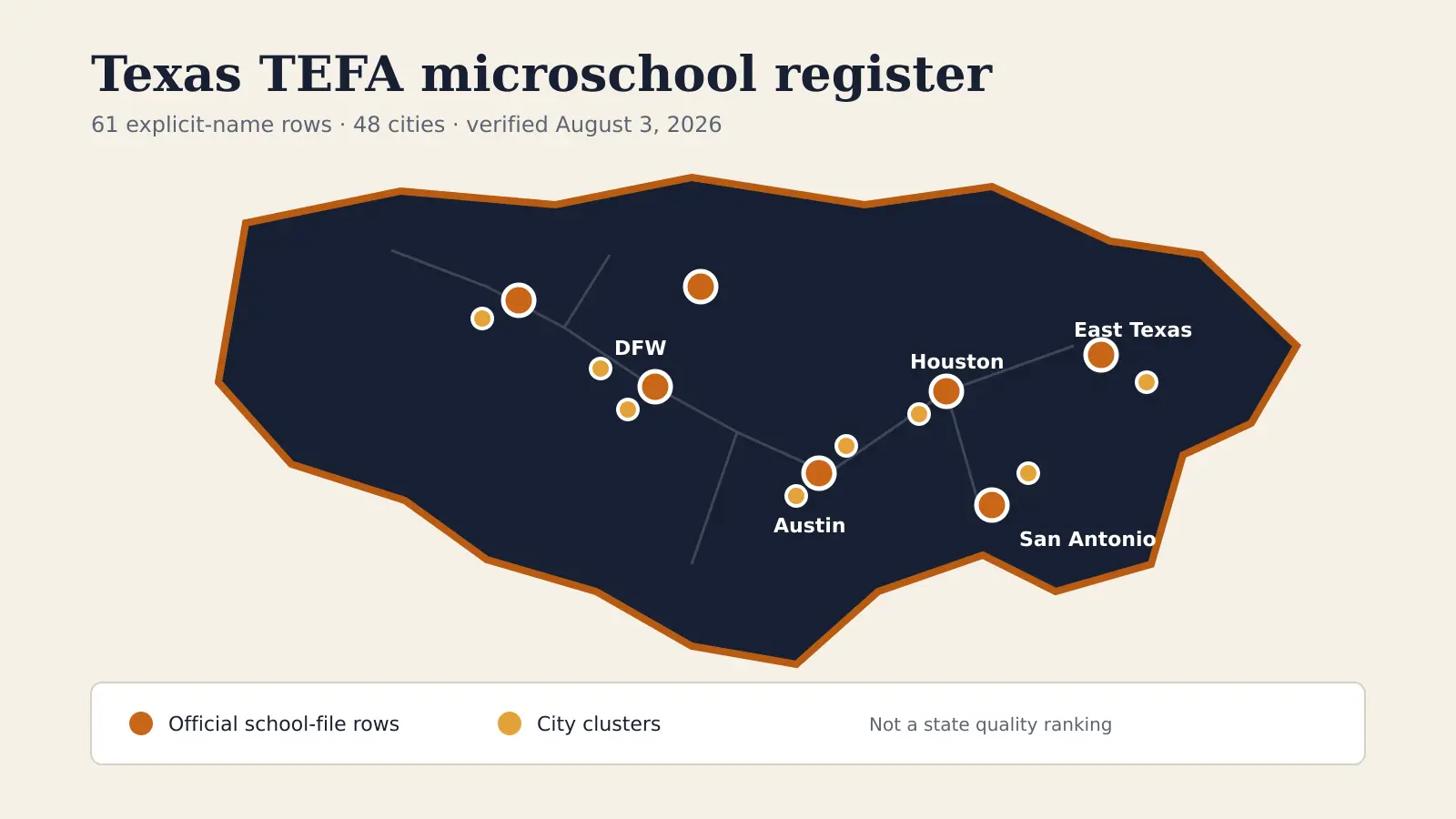
TEXAS TEFA · PARENT COMPARISON · LAST VERIFIED AUGUST 3, 2026
Best Texas ESA Microschools (2026–27): Which Ones Actually Take TEFA Money
By The School Choice Index Editorial Team — an independent comparison and research resource for U.S. school choice programs. Data version: Texas TEFA Microschool Verification Index v1.1 · Last verified: August 3, 2026
The best Texas ESA microschools are small schools that fit your child and show up on the state's participating private school list — not just the vendor list. That classification is what makes the $10,474 private-school path possible; vendor status alone does not change the educational setting already assigned to your child. For 2026–27, an awarded student enrolled in a participating private school receives $10,474. A qualifying student with a current Texas IEP may receive more, up to $30,000. An awarded child in the homeschool/other setting receives $2,000. The 2026–27 application window is closed.
That's an $8,474 swing. Same child. Same school year. Different setting.
Here's the part almost nobody tells you: Texas has no funding category called "microschool." We downloaded the state's own weekly files on August 3, 2026 to see who actually made the list. What we found explains everything about which small schools you can afford right now — and it isn't what the directories are telling you.
Where you stand in 30 seconds
| Your child's setting | 2026–27 amount | What has to be true |
|---|---|---|
| Participating private school | $10,474 | Your child was awarded the private-school setting, that exact school or campus participates, and the school confirms enrollment |
| Participating private school + qualifying current Texas IEP | More than $10,474, up to $30,000 | Same as above, plus a qualifying IEP from 2023–24, 2024–25, or 2025–26 matched through TEA |
| Eligible participating pre-K or kindergarten program | $10,474 | Your child was awarded this setting, meets the state's pre-K rules when applicable, and the exact provider participates |
| Homeschool / other | $2,000 | Your child was awarded or changed down to this setting and you buy approved products and services through the marketplace |
| Vendor-only service | Draws from whatever award you already have | The vendor and the specific offering are approved — but vendor status does not change your award category |
| Public or charter school | Tuition-free public option | Charter schools are public schools. Public or charter enrollment ends TEFA participation for that student. |
Our one honest warning, up front: TEFA does not fund microschools as microschools. If your top priority is spending the full award at any small school you like, that's not how this program works, and a participating private school is the better path. Texas requires participating private schools to document recognized accreditation, an eligible operating history, and annual testing. But a place on the state list is not a quality endorsement, and the exact Texas campus may be newer than two years when the same legal entity operates another qualifying campus. Most microschool directories can't tell you either of those things. If your school didn't make the list, jump to what your $2,000 can really do — that path works only when your child has the homeschool/other award and the provider, offering, and transaction are approved.
Jump to: How the money works · What the state's list shows · The schools · Build your shortlist · Your real cost · Fit for your child · By city · Verify before you pay · IEP families · Downsides · If you got $2,000 · Pre-K rules · How to enroll · Our method
Can you actually use Texas ESA money at a microschool?
Yes — but only at some of them, and the school's size has nothing to do with it. Texas Education Freedom Accounts (TEFA) is the state's education savings account program, created by Senate Bill 2 in 2025 and run by the Texas Comptroller with Odyssey as the account administrator. An awarded child can use the $10,474 private-school amount at a microschool only when the child's locked setting is private school and the exact school or campus participates. A vendor-only microschool can sell approved services, but it cannot convert a $2,000 homeschool/other award into $10,474.
Let's slow down on this, because it's where most families get hurt.
"Microschool" is a model, not a funding category
A microschool is a small learning program, often mixed ages and flexible on days and hours. Great model. Texas law doesn't care what it's called.
What the law cares about is which door the school walked through. There are two.
Door 1 vs. Door 2: participating school or approved vendor
| Participating private school | Approved vendor |
|---|---|
| Confirms your child is enrolled | Sells approved products or services |
| Must clear the participating-school accreditation gate | Must clear vendor and offering review; it does not use the private-school accreditation gate merely to act as a vendor |
| Must demonstrate that the same legal entity has operated a campus for at least two school years | It does not use the participating-school two-year campus gate merely to act as a vendor |
| Must administer an approved annual assessment to participating students in grades 3–12 | It does not use the participating-school annual-testing gate merely to act as a vendor |
| Must be in Texas or, for a virtual school, maintain an office in Texas | May provide approved online or out-of-state offerings after acceptance |
| Supports the $10,474 private-school setting for a child awarded that setting | Uses whatever award the child already has |
Some organizations are in both files. They take tuition as a school and sell approved services as a vendor. That's normal. It's also why you have to check both lists, not one.
The mistake that costs $8,474: a school says "we accept TEFA." True — as a vendor. The parent hears "our tuition is covered." It isn't. Ask which list. Ask whether your exact enrollment option is private-school enrollment. Get both answers in writing.
The three gates a Texas microschool has to clear
For a K–12 private school to participate, all three must be true. There is no provisional shortcut.
- Recognized accreditation. The school must be accredited through TEPSAC or another accreditor recognized by the Texas Education Agency.
- An eligible operating history. The same legal entity must have successfully operated a campus for at least two school years before applying.
- Annual assessment. The school must administer a nationally norm-referenced assessment or the state assessment to participating students in grades 3–12.
Pre-K and kindergarten providers have separate participation routes, covered below.
Who actually counts as a "recognized" accrediting entity
Here's something we verified at the source that many school pages and directories still get wrong.
The Texas Education Agency's current accreditation page recognizes four private-school accreditation entities for the education savings account program:
- TEPSAC — the Texas Private School Accreditation Commission. TEPSAC is a commission whose member associations accredit schools; TEPSAC itself is not the school-level accreditor.
- IALDS — the International Association for Learner Driven Schools.
- SCL — the Society for Classical Learning.
- NAPS — the National Association of Private Schools.
Some older guidance still lists fewer entities. TEA's current page lists four.
Why you should care: a school's accreditation path can change, and the name of a membership association is not enough. If a school near you previously gave up on participation, it is worth one email asking which recognized accrediting entity now covers the school and whether the exact campus appears in the current TEFA file.
"We're working on accreditation" does not unlock the private-school amount
This one is blunt, and we're going to be blunt with you.
When the Comptroller wrote the final rules, two organizations — Choose to Succeed and Primer Microschools — formally asked the state to let good-faith applicants participate while pursuing accreditation. The Comptroller said no. In the adopted rule record, the office wrote that it may not approve a private school that fails to demonstrate accreditation, annual testing, and two school years of continuous operation. A separate commenter asked whether a school with two years of operation under a non-recognized accreditation could join during the process. Also no.
There is no provisional status. No candidacy. No "pending."
So if a school tells you it's mid-accreditation and hopes to be approved by October — believe that they're trying, and plan around the award already shown in your child's account. Do not budget on $10,474 until the exact school or campus is participating and can confirm your child's enrollment.
> Check your school's exact campus in the official TEFA Finder → Takes about two minutes. Search the school's legal name, not its marketing name.
What the state's own list actually shows (and the number that explains everything)
On August 3, 2026 we downloaded the Texas Comptroller's weekly participating-school and participating-vendor workbooks and analyzed them. The school file held 2,786 rows, 2,700 exact school-name strings, and 2,697 distinct names after lowercasing and collapsing spacing. The vendor file held 1,790 rows. When we searched the school-name field for microschool, micro school, and hyphenated or plural variants, we found 61 rows across 48 Texas cities. Fifty-five of those 61 begin with the literal prefix "Prenda Microschool:" in the state file.
Read that last sentence again.
The 55-of-61 finding
| What we counted in the state's school file | Number |
|---|---|
| Total participating-school rows | 2,786 |
| Exact school-name strings after trimming | 2,700 |
| Distinct school names after lowercasing and collapsing spacing | 2,697 |
| Participating-vendor rows | 1,790 |
Rows with microschool, micro school, or a hyphenated/plural form in the listed name | 61 |
Rows carrying the prefix Prenda Microschool: | 55 (90.2%) |
| Other explicit-name microschool rows | 6 (9.8%) |
| Texas cities represented | 48 |
| Explicit-name microschool rows as a share of all participating-school rows | 2.2% |
City concentration in that explicit-name set: Houston has seven rows. San Antonio has three. Denton, Tomball, Humble, Spring, and Allen have two each. Fifty-eight of the 61 start at kindergarten. Fifty-six list eighth grade as their maximum grade. The most recent submission date we saw in that set was July 30, 2026 — the list is still moving.
This is a floor, not a ceiling. Plenty of schools operate as microschools without using the word in their legal or listed name. Our full table below includes those. But the exact-name count is a clean, reproducible measurement, and it tells you something the fuzzy count can't.
The six non-Prenda explicit-name rows
| Official school-list name | City | Grades in the state workbook | What still needs a parent-level check |
|---|---|---|---|
| The Woodlands Microschool, LLC | Conroe | 3–12 | Confirm the published hybrid schedule and price apply to your child's grade |
| Brilliant Microschools | Denton | K–12 | Confirm the exact Texas campus and educational setting for the nationwide online model |
| Austin Micro School | Manchaca | K–9 | The school site says K–12 and shows a ZIP that conflicts with the workbook; confirm the campus and each part-time option |
| Brighter Futures Microschool | Arlington | 1–7 | Confirm current tuition, staff model, schedule, and open seats |
| 12 Stones Christian Microschool | Houston | K–5 | The public site describes grades 1–5 and does not give a clear 2026–27 new-student price |
| Abba Academy Microschool | Denton | Pre-K–8 | Confirm current tuition, schedule, assessment, and enrollment |
Source: our August 3 analysis of the official weekly school and vendor workbooks. The downloadable 61-row register preserves the official name, city, ZIP, grades, assessment field, website, submission timestamp, and source date.
Why 55 of the 61 rows carry the Prenda name
The state workbook proves the branding. It does not contain a public ownership field, so we will not pretend the file proves the corporate relationship behind every row.
When the rules were being finalized, several operators asked whether a school could use an out-of-state campus to satisfy the two-year rule. The Comptroller agreed it could — the qualifying campus does not have to be in Texas, and a school operating as a single legal entity with multiple campuses may use one of its own qualifying campuses to meet the operating-history requirement.
Then KaiPod Learning asked the sharper question: could a new, locally owned school in its network qualify based on accredited campuses run by affiliates? The Comptroller declined to extend the rule that far. A separate affiliate cannot borrow another legal entity's two-year history merely because both belong to the same support network.
So here's the practical shape of the rule in one sentence:
A multi-campus legal entity may open a new Texas campus and apply using the operating history of one of its qualifying campuses. A newly formed independent Texas school generally has to build its own two-year record before it can qualify.
That does not prove why each Prenda-branded row qualified. It does explain why legal structure and scale matter. Networks organized under one qualifying entity can clear the operating-history gate differently from independent founders who form a new entity for one campus.
The National Microschooling Center's 2025 sector survey covered 800 operating and prelaunch microschools, including 550 currently operating schools. Among the operating-school respondents, 74% reported annual tuition and fees of $10,000 or less, while 22% reported current accreditation. Which brings us to the number that frames this whole page:
For most schools in that national survey, the price was below the Texas award. For most, accreditation was not in place. The award is big enough. The door is the problem.
Those are national self-reported sector figures, not a Texas participation count. We're not going to pretend that's fair or unfair. It's just what's true, and you can't plan around a rule you don't know exists.
Best Texas ESA microschools for 2026–27
There is no single best microschool for every Texas family, and any page that gives you one is guessing. Below are category winners based on what we could verify: official status in the state's files, published tuition, published schedule, grade range, stated model, and the school's own statements about what it can and can't support. We do not rank on academic outcomes, because no comparable independent outcome dataset exists for these schools — and we won't invent it.
How to read this table. "Official match" means we found this school or campus in the state's August 3, 2026 workbooks. It does not mean every grade, campus, schedule, or part-time option receives the same TEFA treatment. "Left" means money potentially remaining in the TEFA account if the $10,474 private-school amount applies; it is not cash paid to the family. Confirm the exact option before you pay anything.
| School | Best for | Official match (Aug. 3) | Published 2026–27 cost | Compared with $10,474 | The catch |
|---|---|---|---|---|---|
| House of Emet — Tyler | Best verified value for the school-published full-time K–5 program | School + vendor | $9,750 + $200 fee | Potential $524 account balance | Christian; Tyler only; workbook says K–12 while the current public program page says K–5 |
| MindSprout Montessori — Spring | Best flexible Montessori schedule | School + vendor | $8,400–$15,800 for a new family | Potential $2,074 balance → $5,326 family gap | Confirm whether each two- or three-day option is participating-private-school enrollment |
| The Humanist Academy — Irving | Best broad-age learner-driven DFW option | School | $10,020–$18,000 | Potential $454 balance → $7,526 gap | School states it isn't staffed for serious learning disabilities or specialized attention; no organized sports teams |
| ParagonED — Frisco | Best Christian hybrid K–12 | School + vendor | $12,500 K–8; $15,000 high school | $2,026 or $4,526 gap | Parents support remote days; only Frisco matched; part-time, online, and Southlake treatment need confirmation |
| The Woodlands Microschool — Conroe | Best compressed published hybrid schedule | School | $13,500 including enrollment fee | $3,026 gap | Workbook lists grades 3–12; confirm the public four-day, four-hour terms apply to your child's grade |
| Austin Micro School — Manchaca | Best days-per-week flexibility | School | $5,000–$18,000 | Potential $5,474 balance → $7,526 gap | Workbook and school site disagree on ZIP and grade range; part-time treatment is unconfirmed |
| Prenda Texas | Widest explicit-name geographic reach | 55 Prenda-branded school rows | $2,199 platform fee + guide-set fee | Cannot calculate without the local quote | Fee, schedule, facility, peer group, and day-to-day operation are location-specific |
Best verified value: House of Emet, Tyler
If you're in East Texas and want the school-published full-time Christian K–5 program in a small setting, this is the cleanest math we found in the whole state.
Tuition is $9,750 plus a $200 fee. Total $9,950. The standard award is $10,474. If that award applies and those are your only required charges, you'd finish the year with roughly $524 still sitting in the account for approved expenses — not in your pocket, but not out of it either. Monday through Thursday. Small groups.
One mismatch belongs in the open: the official workbook lists House of Emet as K–12, while the current public enrollment page describes K–5. Confirm your child's grade and exact program before you rely on the state row.
Walk away if: you're not within a reasonable drive of Tyler, you need a grade the school cannot confirm, or you want a school without a religious identity. That's not a knock. It's just a poor fit, and a poor fit at a small school is worse than a poor fit at a big one.
Best flexible Montessori schedule: MindSprout Montessori, Spring
For Houston-area families who want Montessori instruction without a five-day commitment. The school publishes programs for ages 3 through 14, with two-, three-, and four-day choices.
The tuition ladder matters here. For a new family in the early-childhood or elementary core program, two days totals about $8,400 after the published $500 enrollment fee — you'd have around $2,074 left in the account if the private-school amount applies. Four days totals about $13,300, which puts you about $2,826 out of pocket. The highest new-family option we found totals $15,800, leaving a $5,326 gap.
One detail we liked: the school is straight about the home role. Two- and three-day families extend learning at home. The four-day core option does not list the same at-home learning extension. That's the kind of honesty you should expect and rarely get.
Confirm before you commit: whether the two- and three-day options are treated as participating private school enrollment for the $10,474 setting, or billed as a vendor service while your child remains in homeschool/other. That question is worth thousands of dollars and we could not resolve it from published materials.
Best broad-age learner-driven option in DFW: The Humanist Academy, Irving
Ages three through high school, mixed-age groups, Socratic discussion, self-paced work. The school publishes monthly tuition from $835 to $1,500, which annualizes to $10,020–$18,000 — anywhere from a potential $454 account balance to a $7,526 family gap if the $10,474 amount applies.
We're highlighting this school partly because of something it says about itself: it states directly that it is not trained or staffed for serious learning disabilities, special needs, or specialized attention, and that it doesn't currently field organized sports teams.
That's not a weakness. That's a school telling you the truth so you don't enroll a child it can't serve. We wish more of them did it.
Note: don't read the school's name as a statement about religion. Read what the school actually says about its philosophy on its own site.
Best Christian hybrid K–12: ParagonED, Frisco
Project-based, Christian, kindergarten through twelfth. Full-time K–8 is $12,500 — about $2,026 out of pocket after $10,474. Full-time high school is $15,000, so roughly $4,526.
Rolling monthly starts September through April when space allows, and Frisco offers trial days. That's rare and genuinely useful if your child is anxious about a switch.
Three things to confirm: the Southlake campus status, exactly how part-time and online options are funded, and the weekly schedule. Only Frisco matched in our pull, and the published schedule wording is internally inconsistent — you need to know how many days you're covering at home.
Best compressed published hybrid schedule: The Woodlands Microschool, Conroe
The official workbook lists grades 3–12. The school's public hybrid page describes four days a week, about four hours a day, and $13,500 including the enrollment fee. If those terms apply to your child's grade and the $10,474 amount applies, the gap is $3,026.
Short days are a gift for competitive athletes, traveling families, kids in therapy several afternoons a week, and students whose anxiety spikes after hour four. Short days are a problem if both parents work outside the home at 2 p.m. Be honest with yourself about which one you are.
Confirm before you commit: that the published schedule and price apply to your child's grade, not only to one program within the school.
Best days-per-week flexibility: Austin Micro School, Manchaca
One, two, three, or five days. Published tuition runs from $5,000 to $18,000. If the $10,474 private-school amount applies to the exact option, at one day you'd have a potential $5,474 left in the account. At five days you'd owe $7,526.
The school offers a 30-day fit guarantee — but it excludes TEFA-funded tuition. Read that clause yourself before you sign.
Unresolved: the official workbook lists Manchaca with ZIP 76063 and grades K–9; the school's current site lists a Manchaca address in ZIP 78652 and describes K–12. The part-time funding path is also not clear from the public pages. None of those facts automatically disqualifies the school. All three need a direct written answer before you pay.
Widest explicit-name reach: the Prenda network
Fifty-five Prenda-branded locations appear in the state school file — more than every other explicit-name microschool row combined. If geography is your binding constraint, start here.
But understand the model. Prenda charges a $2,199 platform fee, and each local guide sets their own fee on top of that. Guides are independent operators. Prenda says families should do their own location-level safety and fit checks, and it does not certify a guide's facility.
Translation: the platform can be consistent. The room, guide, schedule, fee, and peer group are local. Two Prenda microschools 20 miles apart can feel like different planets. Visit the actual room. Meet the actual guide. Ask what the actual total is.
On the watchlist — officially listed, but not ready for a category win
We're naming these because you'll find them and deserve to know where they stand. We found each one in the official school workbook, but we're not ranking them because we couldn't confirm enough for a category win.
- Brighter Futures Microschool, Arlington — grades 1–7, newly opened. Tuition, staffing, and current seats unverified.
- Brilliant Microschools, Denton — online/nationwide structure. The Texas campus and funding setting need confirming.
- 12 Stones Christian Microschool, Houston — K–5. The public page shows a 2027–28 new-student figure of $30,000 and distinguishes it from grandfathered families. We could not pin down a clear 2026–27 new-student price, so we won't run gap math on it.
- Abba Academy Microschool, Denton — Pre-K–8. Tuition, schedule, and current enrollment need direct confirmation.
> Build my three-school shortlist → Filter by your city, your child's grade, your actual award, and how far you'll drive. No email needed to see results.
Which verified Texas ESA microschools fit your child, budget, and week?
Free shortlist tool · no email required
Start with your location and grade
This first pass uses the 61-row official verification register behind this article. It narrows by city, ZIP, grade, and verified date. The register does not publish tuition, coordinates, schedule, support, philosophy, or coverage fields, so the other preferences are carried into your shortlist questions instead of being guessed.
The register confirms official school-file presence, not that every enrollment option receives this amount.
Enter a city, ZIP, or school name to see up to three rows from the 61-row verification register.
No-result state: when no verified register row matches the selected city, ZIP, grade, or verification filter, broaden the search and confirm the official Finder before paying a deposit.
Use the on-page match and cost tool to turn the statewide list into a three-school shortlist. It should filter the same verification data used in this article by ZIP, grade, actual award, schedule, drive radius, parent-at-home capacity, and maximum family contribution — then show why each result matched and what still needs to be confirmed.
Inputs
- ZIP code or city
- Child's grade
- Actual award amount: $10,474, $2,000, the child's actual IEP-based amount, or a custom amount
- Maximum drive radius
- Full-time, part-time, hybrid, online, or flexible
- Maximum annual family contribution
- Days an adult can support learning at home
- Religious or educational-philosophy preference
- Learning needs and support priorities
- Need for full-day coverage
- Verified-only toggle
What the family gets
- Three best-fit options
- Official school, vendor, both, or unresolved status
- Last-verified date
- Published tuition and estimated family gap
- Parent-workload warning
- Material limitation
- The exact question that still needs an answer
- Official status-check link and the school's next admissions step
The first result screen should require no email. The micro-commitment is choosing a location, grade, award, and schedule — not surrendering contact information before the page has delivered value.
> Start with my ZIP and my child's grade →
What a Texas microschool will actually cost you after TEFA
Your real cost is published tuition, plus required fees, minus your actual award — and "your actual award" is the part families get wrong. The standard 2026–27 participating private school amount is $10,474. Among the Texas microschools we researched, published costs run from $5,000 to $18,000, so families land anywhere from money left in the account to a $7,526 bill.
Here's the math, plainly:
Your cost = tuition + required fees − your awardA positive number is what you pay. A negative number is money still sitting in your TEFA account — not cash coming to you. More on that below.
Every option we researched, priced out
| School and option | Tuition + required published fee | Award used in example | Your estimated cost | Status note |
|---|---|---|---|---|
| House of Emet, school-published full-time K–5 | $9,950 | $10,474 | $0 — potential $524 account balance | Workbook/public-grade mismatch; confirm exact program |
| MindSprout core, 2 days, new family | $8,400 | $10,474 | $0 — potential $2,074 balance | Hybrid funding path unconfirmed |
| MindSprout core, 3 days, new family | $11,000 | $10,474 | $526 | Hybrid funding path unconfirmed |
| MindSprout core, 4 days, new family | $13,300 | $10,474 | $2,826 | School labels this full-time |
| MindSprout core + electives, 2 days, new family | $9,800 | $10,474 | $0 — potential $674 balance | Hybrid funding path unconfirmed |
| MindSprout core + electives, 3 days, new family | $12,900 | $10,474 | $2,426 | Hybrid funding path unconfirmed |
| MindSprout core + electives, 4 days, new family | $15,450 | $10,474 | $4,976 | School labels this full-time |
| MindSprout lower secondary, 2 days, new family | $10,400 | $10,474 | $0 — potential $74 balance | Hybrid funding path unconfirmed |
| MindSprout lower secondary, 3 days, new family | $13,100 | $10,474 | $2,626 | Hybrid funding path unconfirmed |
| MindSprout lower secondary, 4 days, new family | $15,800 | $10,474 | $5,326 | School labels this full-time |
| Humanist Academy, low end | $10,020 | $10,474 | $0 — potential $454 balance | Honor-system tuition |
| Humanist Academy, high end | $18,000 | $10,474 | $7,526 | Honor-system tuition |
| ParagonED, full-time K–8 | $12,500 | $10,474 | $2,026 | Frisco campus |
| ParagonED, part-time K–8 | $6,000 | $10,474 | $0 — potential $4,474 balance | Funding path unconfirmed |
| ParagonED, online K–8 | $5,000 | $10,474 | $0 — potential $5,474 balance | Funding path unconfirmed |
| ParagonED, full-time high school | $15,000 | $10,474 | $4,526 | Frisco campus |
| ParagonED, part-time high school | $7,500 | $10,474 | $0 — potential $2,974 balance | Funding path unconfirmed |
| ParagonED, online high school | $6,500 | $10,474 | $0 — potential $3,974 balance | Funding path unconfirmed |
| The Woodlands published hybrid option | $13,500 | $10,474 | $3,026 | Confirm schedule and price apply to child's grade |
| Austin Micro, 1 day | $5,000 | $10,474 | $0 — potential $5,474 balance | Part-time treatment unconfirmed |
| Austin Micro, 2 days | $9,000 | $10,474 | $0 — potential $1,474 balance | Part-time treatment unconfirmed |
| Austin Micro, 3 days | $12,000 | $10,474 | $1,526 | Part-time treatment unconfirmed |
| Austin Micro, 5 days | $18,000 | $10,474 | $7,526 | Full-time treatment still must match exact campus |
| Prenda | $2,199 + guide-set fee | Varies | Get the local quote first | Location-specific |
Prices are as published by each school when we checked on August 3, 2026. Every calculation assumes the $10,474 private-school amount applies to that exact enrollment option and includes only the published required charges shown. Schools change tuition. Confirm yours in writing.
Leftover money is not a refund
If tuition comes in under your award, that balance stays in the TEFA account. It rolls over year to year while your child stays in the program. It does not come to you as cash.
And if a school refunds a TEFA-funded charge, that refund goes back to the funding source — not to your bank account. Plan your household budget accordingly.
Which school fees TEFA can cover
Generally eligible when required and education-related: tuition and qualifying school fees; textbooks and instructional materials; required uniforms; academic assessments; private tutoring; transportation to or from approved providers; educational therapies not covered by a government benefit; eligible district, online, higher-education, or credential courses; meals provided by a private school; and computer hardware or software within the program's 10% annual technology cap.
Generally not eligible: ordinary before-school and after-school supervision, fundraising charges, and parent-organization fees unrelated to instruction. Check the current official approved-expense list and the tuition-and-fee guidance for participating schools before relying on a charge.
One more protection worth knowing: state guidance says a school shouldn't charge a student different tuition and fees just because that student is on TEFA. If a school quotes you a higher number after you mention TEFA, ask why in writing.
The money doesn't all arrive in August
For participating private-school students, funding is released in installments: 25% beginning July 1, 25% beginning October 1, and the remaining 50% beginning February 1, 2027. Homeschool/other students receive the $2,000 in one installment. Students coming off the waitlist later can receive prorated funding, and the state says a student must confirm the private-school enrollment or homeschool/other setting by September 15 to receive the full annual award.
Schools can set their own payment arrangements. What you must not do is sign a contract that requires the full year's tuition in September if your account won't hold it until winter. Ask the school how they handle the timing gap. Good ones already have an answer.
Check your own dates in your Odyssey account. This is a first-year program and timing has moved.
If your child has an IEP, use your real number
"Up to $30,000" is a ceiling, not a promise. The state says most qualifying students receive less than the maximum, because the amount is based on the child's IEP and the district funding calculation behind it.
So run the math on your actual award, not the headline:
Your actual IEP-based award:        $18,700
Tuition + required fees:            $13,500
Potential balance in your account:       $5,200
Then decide what that potential $5,200 balance should buy — approved therapy, tutoring, assessments, or other eligible expenses — instead of assuming it evaporates.
> Run your own tuition gap in 30 seconds → Enter your award and the school you're considering. We'll show what you'd owe and what would be left.
Which microschool actually fits your child and your week?
The word "microschool" tells you almost nothing about daily life inside the building. Two schools with the same label can differ completely on hours, adult support, peer group, and how much teaching lands on you. The fit questions that matter are schedule coverage, parent workload, group size in practice, and whether the school can name specific supports rather than describing itself as "personalized."
If both parents work outside the home
Rule out one- and two-day options unless you have care covered for the other days. Then ask about:
- Exact drop-off and pickup times
- The school calendar against your work calendar
- Aftercare — is it offered, what does it cost, and remember TEFA generally won't pay for it
- What happens when the teacher or guide is sick
A four-hour day at $13,500 can cost you more in childcare than a $16,000 full-day school. Do that math before you fall in love.
If one parent works from home
You have more options and more risk. Hybrid schedules only work if the at-home day actually happens. Look at MindSprout's two- and three-day options, ParagonED's hybrid, Austin Micro's part-time tiers, and local Prenda schedules.
Ask one question: on home days, who teaches, and what exactly am I responsible for? If the answer is vague, assume it's you.
If your child needs a calmer, smaller room
Don't ask for the maximum class size. Ask for the current enrolled number in your child's group. Then ask:
- How loud is the room at 10 a.m.?
- How often do kids move?
- How is conflict handled?
- Have you had a child like mine, and how did it go?
If your child is self-directed or way ahead
Mixed-age grouping is the real advantage here. Ask how a student moves faster, what happens with advanced high school coursework, and — this is the one people forget — what the school does when a strong student quietly avoids their weakest subject. Self-paced models can hide a gap for a year.
If your child has ADHD, autism, dyslexia, speech needs, or anxiety
We won't name a "best for special needs" microschool, because a small class is not a support plan. Instead, sort every school you consider into one of three buckets:
- The school states it provides this specific support
- The school states it can't
- Unverified — they haven't said
A school that says "we're not staffed for that" is being helpful. A school that says "all neurodivergent kids thrive here" is telling you nothing. There's a fuller checklist below.
If you want a Christian school — or specifically don't
Compare House of Emet, ParagonED, and 12 Stones on identity, model, price, and status. We won't tell you which theology is better; that's your call, not ours.
And if you want a non-religious school, read what each school says about its own philosophy. Don't guess from the name.
If your child is an athlete, performer, or travels
Prioritize short days, hybrid schedules, rolling starts, and remote coursework. Then ask a boring question that matters enormously: do you issue transcripts and high school credit documentation? Get the answer before ninth grade, not during eleventh.
If you have siblings across several grades
Check grade span, sibling discounts, and whether all your kids can attend the same location. Also know that TEFA sibling priority in a future year and school admission are two separate things. One doesn't get you the other.
Compare the schools that fit our schedule and our kid →
Which Texas ESA microschools are near Dallas, Houston, Austin, San Antonio, and East Texas?
The state's participating-school file shows microschool-named programs in 48 Texas cities, but the spread is uneven. Houston has the most explicit-name rows we counted at seven. San Antonio has three. Denton, Tomball, Humble, Spring, and Allen have two each. Most other cities have one — and many have none, which is worth knowing before you spend a Saturday driving.
Dallas–Fort Worth
The Humanist Academy (Irving), ParagonED (Frisco), Brighter Futures (Arlington), Brilliant Microschools (Denton), Abba Academy (Denton), plus local Prenda locations.
The highlighted DFW schools in this comparison span published annual prices from $10,020 to $18,000, before unresolved part-time or online treatment. Run the gap math per school, not per metro.
Houston and the northern suburbs
MindSprout Montessori (Spring), The Woodlands Microschool (Conroe), 12 Stones Christian Microschool (Houston), plus Houston-area Prenda locations.
Spring, Conroe, and The Woodlands appear repeatedly in the researched set. Inside Houston, the explicit-name workbook count is larger, but every row still needs a campus-level check before you plan a tour.
Austin and Central Texas
Austin Micro School (Manchaca), plus Austin and Round Rock area locations.
One warning specific to Austin: at least one popular directory still lists Apogee Dripping Springs, which closed on May 29, 2026. Don't plan a tour around a listing you haven't checked this month. More on that in the next section.
San Antonio
Three explicit-name rows appeared in our pull, all carrying the Prenda prefix.
If you're in San Antonio, ask any new campus directly: are you already on the participating-school list, or applying? A company's history elsewhere does not replace the need to find the exact Texas campus in the current state file.
East Texas
House of Emet in Tyler is the best verified value among the full-time options we priced on this page, subject to confirming the workbook/public-grade mismatch.
Rural Texas and online options
Keep three things separate in your head:
- Participating virtual private schools — can support the $10,474 setting
- Vendor-only online programs — draw on whatever award you already have
- Homeschool co-ops — may be vendors, participating schools, or outside the program; verify the exact entity and offering
An online program can be excellent and still use only the award already assigned to your child. Ask which of the three it is.
Find verified options within my drive radius →
How to verify a microschool before you pay a deposit
Check the state's own records for your exact campus, then get the school's answers in writing. A directory listing is not proof, a school's website is not proof, and "we accept TEFA" is not an answer — it doesn't tell you whether your child is funded as a private school student or a homeschool student.
We'll show you exactly why this matters.
Proof that directories go stale
Apogee Dripping Springs closed on May 29, 2026. As of our check on August 3, 2026 — more than two months later — it was still displayed as open in KaiPod Learning's Texas microschool directory.
We're not pointing this out to attack anyone. Directories are hard to maintain and this one is genuinely useful. We're pointing it out because a parent in Dripping Springs could have spent a week planning around a school that no longer exists.
While we were in that same directory, we found a second problem: it names the Texas Private Schools Association as an example of a recognized accreditor. TPSA is a membership and advocacy association for private schools. It's a real and respected organization. It is not one of the accrediting entities on TEA's current list. The rule points to accreditation recognized through TEPSAC or another accreditor recognized by TEA.
A parent could hear "we're a TPSA member" from a school and believe the accreditation box is checked. It isn't.
Elsewhere, we found a Texas private-school directory still showing a March 17, 2026 TEFA deadline, even though a federal court order extended the application window and the official portal closed at 11:59 p.m. Central on March 31.
Every one of those errors was live on a public page families could reasonably use on the day we checked. That's why the ten minutes below are worth it.
The one email to send before the tour
Please confirm the exact legal name and campus that appear in the TEFA system, whether this exact enrollment option is participating-private-school enrollment or a vendor service, the total mandatory tuition and fees, and how the payment schedule works with TEFA installments. Please also confirm the withdrawal and TEFA-refund terms in writing.
If the school cannot answer that email cleanly, you are not ready to pay a deposit.
The 10-point verification checklist
- Exact legal name — does it match the state listing, not just the sign on the door?
- Exact campus — is this location included, or just the flagship?
- Which file — participating school, vendor, both, or neither?
- Your enrollment option — is your two-day or hybrid choice treated as private school enrollment?
- Currently operating — open for the coming term, with recent evidence?
- Tuition and fees — what's required, what's optional, what's refundable?
- Payment timing — does their schedule match when TEFA funds actually land?
- Staff and safety — background checks, supervision, who can enter, emergency plan
- Supports and rights — what can they provide, and what changes when you leave public school?
- Exit — withdrawal terms, what happens if they close, who holds records, how refunds work
Red flags
- "We accept TEFA" with no answer about school vs. vendor
- Pressure to pay a deposit before status is confirmed
- No written tuition or refund policy
- A different legal name on the invoice than on the sign
- "We serve all learners" with no specifics
- No plan for records if the school closes
- No clear answer about who teaches on home days
- Any claim that an IEP automatically means $30,000
> Download the printable tour scorecard → One page. Every question above, with room to write their answers. Take it with you.
Is a Texas ESA microschool a good fit if your child has an IEP or a disability?
A microschool can be a good fit for a child with a disability, but a small class is not the same as specialized instruction — and private schools do not carry the same legal duties as public districts. Texas says so directly in its own family materials: a private school is not subject to federal and state disability-service laws the way a public district or open-enrollment charter school is. A qualifying current Texas IEP from 2023–24, 2024–25, or 2025–26 may raise your award above $10,474, but the state also says most qualifying students receive less than the $30,000 maximum.
This is the section where we most want you to slow down.
Priority and funding are two different things
- A qualifying disability document may improve your priority in the lottery.
- Only a current, matched IEP supports the higher award.
- The amount is based on your child's IEP and the district funding calculation behind it.
- A 504 plan does not qualify for the higher tier.
What changes when you leave the public system
At a public school, an eligible child has an individual right to a free appropriate public education under IDEA, an enforceable IEP, and procedural safeguards. A child placed by a parent in a private school generally does not have an individual right to the same services or the same public-school IEP implementation; public districts retain child-find duties and may provide limited equitable services under federal rules. Some private schools serve kids with disabilities beautifully. But the rights and enforcement mechanism are different, and you should walk in knowing that rather than discovering it in February.
Ten questions to ask every school
- Who delivers specialized reading instruction, and what training do they have?
- Can you implement my child's current accommodations? Which ones can't you?
- How do you handle behavior?
- Is speech, occupational, or behavioral therapy available on site?
- Can an outside therapist come to campus?
- How do you communicate progress, and how often?
- What happens if my child's needs exceed what you can do?
- Do you write any kind of written service plan?
- Have you served a child with a similar profile? What happened?
- What do you not provide?
That last one is the most useful question in this entire article. A school that can answer it clearly is a school that knows itself.
What good disclosure looks like
The Humanist Academy states plainly that it is not trained or staffed for serious learning disabilities or specialized attention. We consider that a mark in its favor, not against it. A school that tells you what it can't do is protecting your child.
A parent worth listening to
When Texas opened the TEFA rules for public comment, hundreds of families and organizations wrote in. One parent, writing about a child with profound disabilities, told the state that for her child, "quality of life, independence, and communication" improvements mattered as much as academic gains — and that a standardized test can't measure them.
The state's rules still require the testing. Her comment is in the public record anyway, and it names something every parent in this situation feels: the thing your child needs most may not be the thing the program is built to measure.
Hold onto that when you tour. Ask about the outcomes you actually care about.
> Get the support questions to ask each school → The full list, printable, organized by what you're trying to find out.
The honest downsides of Texas ESA microschools
Microschools trade scale for intimacy, and that trade has real costs: tuition gaps, parent workload, thinner extracurriculars, different disability protections, and a greater need to verify continuity than at a long-established school. None of these should stop the right family. All of them should be priced in before you sign.
An award is not a funded account
As of the state's July 29, 2026 update, Texas reported roughly 274,000 applications, more than 248,000 eligible applicants, more than 122,000 awards issued — and 85,344 funded accounts.
Do that subtraction. The snapshot shows a gap of more than 36,000 between awards and funded accounts. The report says the process was still ongoing and that some notified families had not yet confirmed participation; it does not assign every unfunded award to a single reason.
Meanwhile, more than 121,000 students remained on the first-year waitlist.
The lesson: an award notice is a step, not a finish line. For the private-school setting, the school must confirm enrollment before funding. Homeschool/other families confirm that setting directly.
The award may not cover tuition
Look back at the cost table. Many of those options leave a bill. A $7,526 gap is a car payment.
Small schools can move, shrink, or close
Apogee Dripping Springs closed in May 2026. That's not an indictment of microschools — small schools can be strong and durable — but it proves why continuity belongs in the decision. A small enrollment base, a leased space, or heavy dependence on one founder can make a transition harder when something changes.
Ask: how long is the lease? How many students are enrolled right now? Who holds academic records if you close?
Parent workload can be real
Some hybrid schools are explicit that you teach on home days. Others don't say. The silence is the warning.
Aftercare and driving can erase the savings
TEFA may cover qualifying transportation. It generally won't cover before- and after-school supervision. If a short-day school adds 45 minutes of driving twice a day plus paid aftercare, the "cheaper" school isn't.
Sports, labs, clubs, and advanced courses may be thinner
Some microschools have none. If your kid's identity is wrapped up in varsity anything, take that seriously.
"Personalized" is a marketing word
It is not a synonym for trained, credentialed, or specialized. Ask for specifics every single time.
There's no scoreboard
There is no comparable, independent academic outcome data for these schools. The state's own school finder doesn't display academic performance data for participating private schools. So when we say "best," we mean best fit against verified facts — status, cost, schedule, transparency, and stability. We don't mean best test scores, because nobody can honestly tell you that yet.
If this list of downsides is a dealbreaker
Good. That's useful information, and it means the system worked.
If you need tuition-free school, public-school IDEA processes, district transportation, organized athletics, or a big peer group, a public school, a public charter school, or a district transfer may serve your child better than any microschool on this page. Public charter schools are public schools — tuition-free and open to eligible students subject to enrollment rules and capacity, not part of the private-school side of TEFA. People blur that line constantly and it causes real confusion.
Our Texas public and charter school guides walk through those options honestly. Go read those instead. We'd rather lose you to the right school than keep you on the wrong one.
What if you only got the $2,000 homeschool/other award?
Don't build a budget around $10,474 if your account was funded as homeschool/other. The $2,000 award is real money and it buys real things through the approved marketplace — but a part-time microschool arrangement doesn't automatically convert your child into a participating private school student, and after the application window you can change only to a setting that reduces funding, not to one that increases it.
Here's how to get the most out of it.
What $2,000 realistically covers
Depending on what's approved: part of a platform and guide fee, one day a week of enrichment, tutoring, curriculum, assessments, approved educational therapies, online courses, instructional materials, and eligible technology within the 10% annual cap.
Check that the specific provider and offering are approved before you count on it.
Two rules that quietly decide whether this works at all
There are no parent reimbursements. You cannot pay a school or provider out of pocket and then submit the receipt for repayment. The provider, offering, and transaction must move through the approved purchasing system. If the microschool or offering is not approved in the system, TEFA money cannot reach it — no matter how legitimate the school is.
You cannot use TEFA funds to pay a family member. The official family page states that funds may not be used to pay a family member, and the adopted rules include related-party restrictions. Do not treat an LLC or nonprofit wrapper as an automatic workaround. If a family member owns, controls, works for, or receives money from the provider, get a written determination from Odyssey or the Comptroller before attempting the transaction.
The one question that separates $2,000 from $10,474
Ask any school offering part-time or hybrid enrollment, word for word:
"For this exact two-day option, do you confirm my child as enrolled in a participating private school — or do you invoice us as a vendor while my child stays in the homeschool/other category?"
Get it in an email. Save the email.
A worked example
Homeschool/other award:            $2,000
Platform or program cost:          $2,199
Local guide or instructor fee:     $3,600
What you'd pay:                    $3,799
That's illustrative, not a quote. Guide fees vary by location and you need the real number from the real person.
> See what services work with a $2,000 account → Our guide to approved TEFA expenses, sorted by what actually helps a part-time learner.
Do pre-K and kindergarten microschools play by a different rule?
Yes — pre-K and kindergarten providers have separate participation routes, and a small Montessori-style program that could not qualify as a K–12 private school may qualify here. A qualifying awarded child in a participating pre-K or kindergarten program receives the standard $10,474 amount, not the $2,000 homeschool/other amount. The provider and child must both qualify.
This is the most overlooked opening in the whole program.
The five provider routes
The official school guidance says a participating pre-K or kindergarten provider must be located in Texas, licensed by and in good standing with the Texas Department of Family and Protective Services, and meet one of these routes:
- Be accredited by a research-based, nationally recognized, universally accessible system approved by the commissioner of education
- Be a Texas Rising Star provider with a three-star certification or higher
- Participate in Texas School Ready!
- Have a qualifying partnership with a school district to provide pre-K
- Be accredited by an organization recognized by TEPSAC
Texas Rising Star and Texas School Ready! are qualifying routes, but they are not interchangeable with private-school accreditation. Calling all five routes "accreditations" would be wrong.
Which national systems the Comptroller addressed in rulemaking
In the adopted-rule comments, the Comptroller said these submissions met the nationally recognized accreditation-system route:
- American Montessori Society (AMS)
- Cognia
- National Administrator Credential (NAC)
- NAEYC
- NECPA
The agency said the submissions for Association Montessori International (AMI) and International Montessori Council (IMC) did not meet that specific route as presented. That does not mean a provider connected to AMI or IMC can never participate; it may qualify through Texas Rising Star, Texas School Ready!, a district partnership, TEPSAC-recognized accreditation, or another accepted route.
Why this matters more than it sounds
Two Montessori microschools can look identical to a parent — same materials, same trained guides, same beautiful room. One may qualify through AMS. Another may qualify through a different route. A label on the wall is not enough; ask which TEFA route covers the exact provider.
It can also mean that a school's pre-K program qualifies through the early-childhood rules while its third-grade program has to satisfy the K–12 private-school rules.
If your child is in pre-K, this is the first question to ask: which TEFA provider route covers this exact program?
For 2026–27, the official program required a pre-K child to turn three before September 1, 2026 and meet at least one free-public-pre-K category, including limited English proficiency, economic disadvantage, homelessness, specified military-family status, qualifying foster-care or conservatorship history, being the child of a Star of Texas Award recipient, or being the child of an eligible public-school classroom teacher. Confirm the exact rule and documentation before you plan around it.
How to enroll after a TEFA award
Accept the award, verify the campus, get admitted, select the school in Odyssey, and make sure the school confirms your enrollment by your deadline. A TEFA award does not admit your child anywhere — schools still run their own admissions — and, for the private-school setting, your account doesn't fund until the school confirms.
The eight steps
- Check the setting on your award. Private school or homeschool/other. After the application period, you can change to a setting that reduces funding, but not one that increases it.
- Verify the exact campus in the state's Finder. Screenshot it with the date.
- Apply and tour. The school decides on admission. Separately.
- Get everything in writing — tuition, required fees, deposit, payment schedule, financial aid, TEFA treatment, withdrawal terms, refund handling.
- Select the school in Odyssey.
- Confirm the school verified your enrollment. Follow up. Don't assume.
- Plan around the installments. The money doesn't all arrive in August.
- Keep records — award notice, school agreement, invoices, your status screenshot, payment records.
Key dates for 2026–27
The application window ran February 4 through March 31, 2026 and is closed. The original March 17 deadline was extended by a federal court order.
For the first funding rounds, the parent and the school had different deadlines:
| Step | First round | Second round |
|---|---|---|
| Parent opts in and selects the participating school | June 1 | July 15 |
| School confirms enrollment | June 15 | July 31 |
| Funding begins | July 1 | Mid-August |
A private-school student confirmed by September 15 could still receive the full annual award; later waitlist awards may be prorated.
If you're reading this after those dates and you weren't awarded, you're planning for 2027–28 or waiting on the waitlist — which is still moving as families opt out.
The next window
Texas hasn't published 2027–28 application dates yet. Don't trust any page that gives you one. Join the official interest list so you hear it from the state.
One planning move worth making now: if the microschool you want is close to qualifying — the same legal entity reaches two completed school years, or recognized accreditation is nearly complete — ask the director exactly where the school is in the process. A school that is ineligible today may be eligible for 2027–28. Put the date in your calendar and check back.
Open the official TEFA Finder and confirm your campus →
How did we choose and verify the best Texas ESA microschools?
We started with the state's own participating-school and participating-vendor workbooks, then checked each school's published tuition, schedule, grades, model, and stated limitations. Our "best for" labels are editorial conclusions drawn from those verified facts. They are not claims that one school produces better academic results, because no comparable outcome data exists for these schools.
Our source order
- Texas statute, the Comptroller's adopted rules, federal court orders when they changed a live deadline, TEA guidance, and official program pages
- The official TEFA Finder and the state's weekly school and vendor workbooks
- Each school's own current tuition, admissions, calendar, and policy pages
- Direct written confirmation from the school
- Reputable local reporting for openings and closures
- Directories — as a starting point for discovery only
- Parent forums — for language and decision friction only, never for policy or eligibility facts
How you can reproduce our count
- Download the current participating-school and participating-vendor workbooks from the state's toolkit page
- Normalize capitalization and spacing in the name column
- Search the school file for
microschoolandmicro school, including hyphenated and plural forms - Count rows, distinct names, and cities
- Separate rows carrying the
Prenda Microschool:prefix from the six other explicit-name rows - Cross-check each name against the vendor file to find schools in both
You'll get our numbers, or you'll get today's numbers — which is the point. The list moves weekly. Our August 3 file contained 2,700 exact trimmed name strings and 2,697 distinct names after lowercasing and collapsing spacing; we report both so the normalization step is transparent.
What "best" means on this page
"Best" means best fit for a defined family need using verified status, published affordability, schedule, model clarity, transparency, school-stated support limits, and continuity checks. It does not mean highest test scores, best teachers, guaranteed outcomes, or universal quality.
What we actually verified
We verified: each school's presence in the state's August 3, 2026 workbooks; current award amounts and program rules from official sources; published tuition and required fees from each school's own site on August 3, 2026; published schedules and grade ranges; each school's own written statements about its model and limitations; current operating or closure evidence where cited; and the accreditation recognition list on TEA's site. We did not verify: teaching quality, individual staff credentials, seat availability, parent satisfaction, safety conditions, academic outcomes, or the TEFA funding treatment of any option we've marked as unconfirmed. We did not visit these schools.
Corrections
Data version 1.1. Last verified August 3, 2026. Next scheduled review: September 1, 2026, or sooner if Texas publishes a new list or a school changes its tuition, location, or status.
If you run a school on this page and something here is wrong or out of date, report a correction and we'll recheck it and update the row with a new verification date. We publish a change log. You can also download the 61-row source register.
Frequently asked questions about the best Texas ESA microschools
The fastest answers are below, with the full reasoning and proof in the sections above. These answers cover classification, funding, cost, admission, disability rules, deadlines, and what to do when a school closes.
Is "microschool" an official Texas TEFA category?
No. Texas recognizes participating private schools, participating pre-K or kindergarten providers, and approved vendors. "Microschool" describes the model, not the funding path; the participating-school path supports the $10,474 amount for an awarded child in that setting.
Can any Texas microschool accept TEFA?
No. As of August 3, 2026 we counted 61 rows in the state's 2,786-row participating-school file whose names matched microschool, micro school, or a hyphenated/plural variant. That is an explicit-name floor, not a count of every Texas school using a microschool model.
How much is the Texas ESA award for private school?
$10,474 per awarded student for 2026–27 when the child attends a participating private school or qualifying participating pre-K or kindergarten program. State law sets the standard amount at 85% of the statewide average state-and-local public-school funding per student, and TEA calculated the 2026–27 amount.
Does an IEP guarantee $30,000?
No. A qualifying current Texas IEP from 2023–24, 2024–25, or 2025–26 can support an amount above the standard award, up to a $30,000 ceiling. The state says most qualifying students receive less, because the amount is based on the child's IEP and the district's funding calculation.
How much do homeschool students get?
$2,000 for an awarded child in the homeschool/other setting for 2026–27, released in a single installment.
Can the $2,000 pay for a part-time microschool?
Sometimes — if the provider and the specific offering are approved and the transaction is eligible. But ask directly whether that arrangement is billed as a vendor service or counts as participating private school enrollment. The answer is worth $8,474.
Can a microschool charge more than the award?
Yes. You pay the difference. Among the schools we researched, that difference ranged from $0 to $7,526.
Can a school charge TEFA students higher tuition than everyone else?
State guidance says a student shouldn't be charged different tuition and fees solely because they receive TEFA. Schools may still have different standard prices for different grades or schedules.
Can TEFA pay enrollment and registration fees?
Required, qualifying enrollment and registration fees can be eligible. Optional charges and non-instructional fees are not automatically eligible; use the current state guidance for the exact charge.
Can TEFA pay for aftercare?
Ordinary before-school and after-school supervision is generally not an eligible expense under the current tuition-and-fee guidance.
Do unused funds roll over?
Yes, while your child stays in the program. A leftover balance is not a cash refund, and TEFA-funded refunds return to the funding source rather than to your bank account.
Does an IEP or a listing guarantee my child a seat?
No. Program participation, a current state listing, a TEFA award, and school admission are separate. Schools run their own admissions and capacity decisions.
Are religious microschools allowed?
Yes, if they meet the program's requirements. Several of the schools on this page are explicitly Christian.
What happens if my microschool closes mid-year?
Contact the program administrator immediately, preserve your records, confirm how refunds are handled, and identify another eligible setting. Ask about this before you enroll, not after.
How often does the participating-school list change?
The state publishes weekly school and vendor workbooks, and new participants are added on a rolling basis. The most recent submission date we saw in our August 3 pull was July 30, 2026.
Does a 504 plan qualify a child for the higher IEP-based award?
No. The higher funding amount depends on a qualifying current Texas IEP matched through TEA. Other disability documents can affect priority, but they do not establish the IEP-based funding amount.
Does appearing in the official school file prove the school is high quality?
No. It verifies program participation information supplied through the state process. It is not a state ranking, safety inspection, academic endorsement, seat guarantee, or finding that the school fits your child.
Are there nonreligious Texas ESA microschools?
Yes, but do not infer a school's religious or nonreligious identity from its name. Read the school's own mission and policies and ask how belief, worship, or religious instruction appears in the school day.
Can a public or charter school receive the private-school TEFA award?
No. Charter schools are public schools. A student found enrolled in a public or charter school is removed from TEFA participation for that school year.
Are applications open right now?
No. The 2026–27 window ran February 4 through March 31, 2026 and is closed. Texas has not published 2027–28 application dates; use the official interest list rather than a predicted date.
Is TEFA first come, first served?
No. The first year used statutory priority groups and a lottery when demand exceeded funding. Applying early didn't improve your odds.
Still not sure which path is right for your family?
Take our free 60-second school choice matching quiz.
Answer a few questions about your child, your award, your city, and your schedule. You'll get a personalized school choice action plan — the funding path that applies to you, the schools that fit, and your exact next step.
No account required to see your results.
About this page. The School Choice Index is an independent comparison and research resource for U.S. school choice programs. We built this comparison because a Texas parent shouldn't have to open a state spreadsheet, a vendor list, five school websites, and a special-education notice just to find out whether a small school is a realistic option.
Editorial independence. No school pays to be included, removed, ranked, or described more favorably. We have no financial relationship with any school, network, or accrediting body named on this page.
What this page is not. Nothing here is a guarantee of admission, funding, or any outcome. Program rules, award amounts, and participation lists change. Verify your own school and your own award before you sign anything or pay a deposit.
Last verified: August 3, 2026 · Data version: 1.1 · Report a correction · Download the dataset (CSV) · Change log
Related: Texas TEFA program guide · Approved TEFA expenses · How to use the Odyssey marketplace · Providers that accept ESA funds near you · How to get a microschool approved (for operators) · Our methodology · Corrections policy
Primary program sources
- Texas Education Freedom Accounts — official program home
- Families: eligibility, prioritization, special-education notice, and approved expenses
- Schools: participation requirements for private schools, pre-K, and kindergarten
- Funding timelines and installments
- Official TEFA toolkit and weekly school/vendor workbooks
- Texas Education Agency accreditation status
- Texas Comptroller adopted TEFA rules and public-comment responses
- 2026–27 TEFA Annual Demographic Report